Category: Street Photography

  • Three Times the Same Stranger

    Three Times the Same Stranger

    The weirdest coincidence I’ve ever experienced didn’t happen to me. It happened inside one of my photographs.

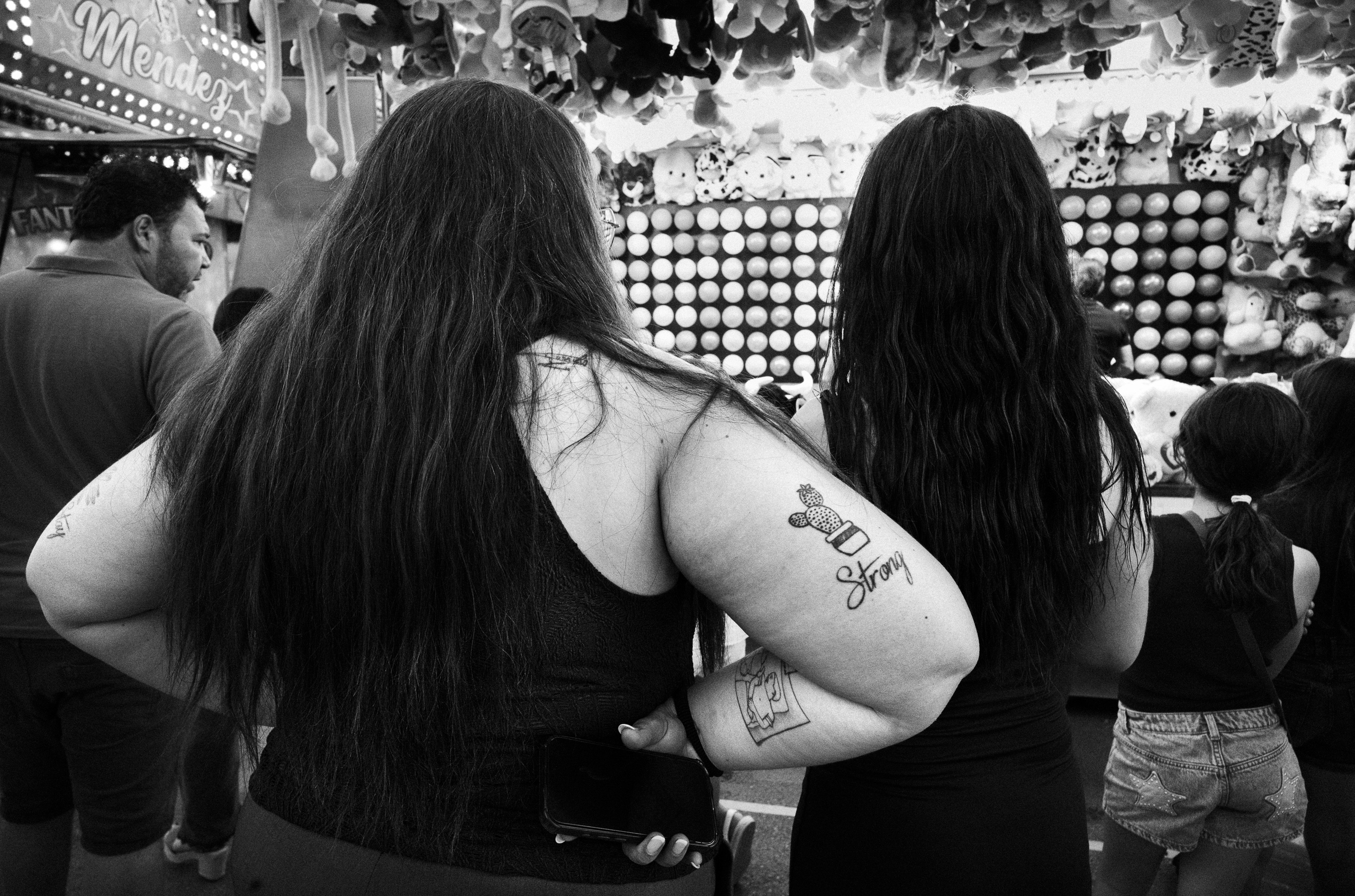
    At a fairground, I raised the camera because of an embrace, an exposed arm and a small cactus tattooed above the word Strong. That was enough.

    Later, while editing, I noticed the rest: three female figures with dark hair and black tops, all facing away from me, arranged from largest to smallest. They looked like three versions of the same person, or one life moving backwards through the frame.

    I hadn’t planned any of it. For a fraction of a second, the street put everything in exactly the right place.

    The camera noticed the joke before I did. As usual.

  • Feeding Time

    Feeding Time

    A horse eats from a bucket. The pigeons close in. People pass, wait, work, disappear into the background.

    Nothing dramatic. Just the city dividing up a few square metres of pavement according to rules nobody wrote down.

    The horse gets fed. The pigeons steal what they can. The humans keep moving.

    Leica M10 Monochrom · Elmarit-M 28mm f/2.8 ASPH.

    From series Urban Wildlife.

  • Liberty Takes Quarters

    Liberty Takes Quarters

    On Liberty Island, three coin-operated viewers stand in line before a horizon that was already free.

    The nearest one has all the authority: metal face, twin eyes and a small order stamped across its mouth: QUARTERS ONLY. Then a seagull crosses the frame without paying, without focusing and apparently without feeling any need to improve the view.

    The 17mm exaggerates the distance between the machines and turns the closest one into something halfway between street furniture and a minor government official. The bird arrived late and saved the photograph. Without it, this might have been a very tidy architectural exercise. A terrible fate.

    Technical: Leica M10 Monochrom · Lomography Atoll Ultra-Wide 17mm f/2.8.

    More Absurd World here.

    Before and after editing.
  • Soft Target

    Soft Target

    Fairground stalls do not leave much room for looking properly. Lights, stuffed prizes, rows of white targets, people drifting in and out. Too much of everything.

    What held me was the arm.

    The woman on the left had Strong tattooed under a small cactus. A detail almost too convenient, honestly. The kind of thing that can hijack a photograph if you let it. But the gesture beside it was better: her arm around the other woman, the phone dangling behind her back as if she had forgotten it was there.

    I left the man on the left and the child on the right. They crowd the frame and make it slightly harder to read. That helped. Without them, the image becomes cleaner, more private and probably weaker. The 21mm kept everyone inside the same mess: lights, prizes, targets, bodies, waiting.

    The top of the stall is close to blowing out. The lower half nearly disappears into hair and black clothes. I could have fixed that a little. I did not. The imbalance felt right.

    The tattoo gave me the easy title. I went elsewhere. Soft Target felt less tidy, which was the point. Strength on the skin, a quiet gesture, all those targets behind them.

    Technical: Leica M10 Monochrom · Thypoch Ksana 21mm f/3.5 Asph.

    Before and after editing.
  • Plastic Karma

    Plastic Karma

    Enlightenment arrived by compressor.

    A colossal figure has settled in the middle of an ordinary street. Eyes closed. Palms open. Expression beyond complaint. Behind it: tired render, garage doors, utility boxes, a streetlamp and wires crossing the sky with the usual civic indifference.

    The figure offers serenity, but the seams are visible. So are the cords. Transcendence, apparently, requires anchoring points.

    This is where Plastic Karma begins: not with plastic as rubbish, but with plastic as belief. A temporary deity, light enough to be folded, transported and stored after use. The sacred has become inflatable—not destroyed, merely made practical. There is probably a compressor somewhere outside the frame doing the real spiritual work.

    The ultra-wide view gives the figure nowhere to hide. It fills the street and still belongs to it. The raised hands almost touch the surrounding houses; the elaborate crown rises into the web of cables. Monument and neighbourhood collide without ceremony. One was built to astonish. The other has seen invoices.

    At ground level, a small weighted anchor sits beside the immense body, an undignified detail that improves everything. Every vision needs ballast. Every god needs somebody to stop it rolling down the road.

    The face remains composed.

    Plastic is good at that.The goddess arrived folded.

    By the time I found her, she had taken possession of the street: a vast inflatable woman with closed eyes and open hands, wedged between garage doors, rough plaster and domestic wiring. The houses looked older for having her there. She looked cheaper.

    Her expression has the irritating serenity of things that never have to pay for themselves. The crown rises into the cables. Her elbows nearly touch the walls. Thin ropes hold her body in place, and beside one foot sits a small weight—the practical detail that ruins the miracle and makes the photograph.

    The 17mm lens leaves no room for respectful distance. She swells towards the frame while the street presses back: a lamp, a balcony, corrugated roofing, the number five above a dark doorway. Nothing has been prepared for revelation. Someone has simply inflated it between the usual routines.

    That is the useful tension. The figure is too large to ignore and too obviously temporary to believe in. She may be a goddess, an advertisement, festival decoration, or all three. Faith with a valve. Grandeur delivered by van and packed away before Monday.

    The face keeps its composure. The stitching runs down the cheeks and chin. Air holds everything together.

    For now.More shots in Absurd World.

    Technical: Leica M10 Monochrom · Atoll Ultra-Wide 17mm f2.8.

  • The Game Looked Back

    The Game Looked Back

    Childhood does not always look innocent in public.

    Sometimes it runs across a square with one foot almost off the ground, a small dark object in one hand, and a face that seems to understand the camera before the camera has time to understand the scene. The game is probably harmless. The photograph is not required to be.

    That is where the image sits.

    The square carries on with its usual civic indifference. People sit on benches. Others cross in the background. A tree cuts the frame. The paving stones draw their little grid of public order, because cities enjoy pretending that geometry can manage human behavior. It cannot, obviously. The boy breaks through it with the directness of movement, and the photograph starts to tilt away from documentation into something less comfortable.

    What holds the frame is not the object in the hand, although it charges the image with a bad little current. What holds it is the look. The child is running, but he is not simply passing through the photograph. He turns toward it. For a second, the game looks back.

    That look changes the scene. Without it, the image would be movement: a child crossing a square, a loose street moment, a figure in motion. With it, the square becomes a small stage where play borrows the shape of adult nonsense. Not danger, not drama in the theatrical sense. Something smaller and more irritating. A rehearsal of gestures the world has already made available.

    This is why the photograph belongs to Small Dramas. Not because something spectacular happens, but because the scene carries more pressure than its surface admits. The gesture is minor. The tension is not. The background stays calm, almost bored, which makes the central movement sharper. The adults do not react. The benches do not care. The city, that great specialist in pretending nothing is happening, continues to be itself.

    Black and white helps remove the soft explanations. No color to make the square pleasant. No festive excuse. Just stone, bodies, benches, trees, a running figure, and the uncomfortable little weight of a game that has learned too much from the public world around it.

    The photograph does not accuse the child. That would be cheap, and the world already produces enough cheap accusations before breakfast.

    It looks instead at the scene that made the gesture readable.

    More Absurd World here.

  • Ritual Pressure

    Ritual Pressure

    Sant Joan does not need more spectacle. It already has enough.

    What interested me was the pressure around it: bodies packed into narrow streets, hands looking for balance, the animal becoming public weather, the crowd pretending it can control what it has summoned.

    The horse is not always the subject. Sometimes the subject is the space it removes from everyone else. The bent neck, the raised legs, the hands against the wall, the phone too close, the face half-hidden by heat and noise. The ritual holds because it nearly stops holding. That edge is where these photographs sit.

    Ciutadella gives the event a beautiful frame. These photographs do not obey that frame for long. They stay closer to the crush, the sweat, the uniform, the balcony, the interior rooms before the street swallows everything again.

    Black and white strips away the festive explanation and leaves weight: skin, stone, cloth, shadow, animal muscle, public fatigue.

    This is not a guide to Sant Joan.

    It is a first edit from inside the pressure.

    Technical note: Sant Joan de Ciutadella, 2026. Black and white street photography. Leica M10 Monochrom / Ricoh GR IV Monochrome · Lightroom Classic.