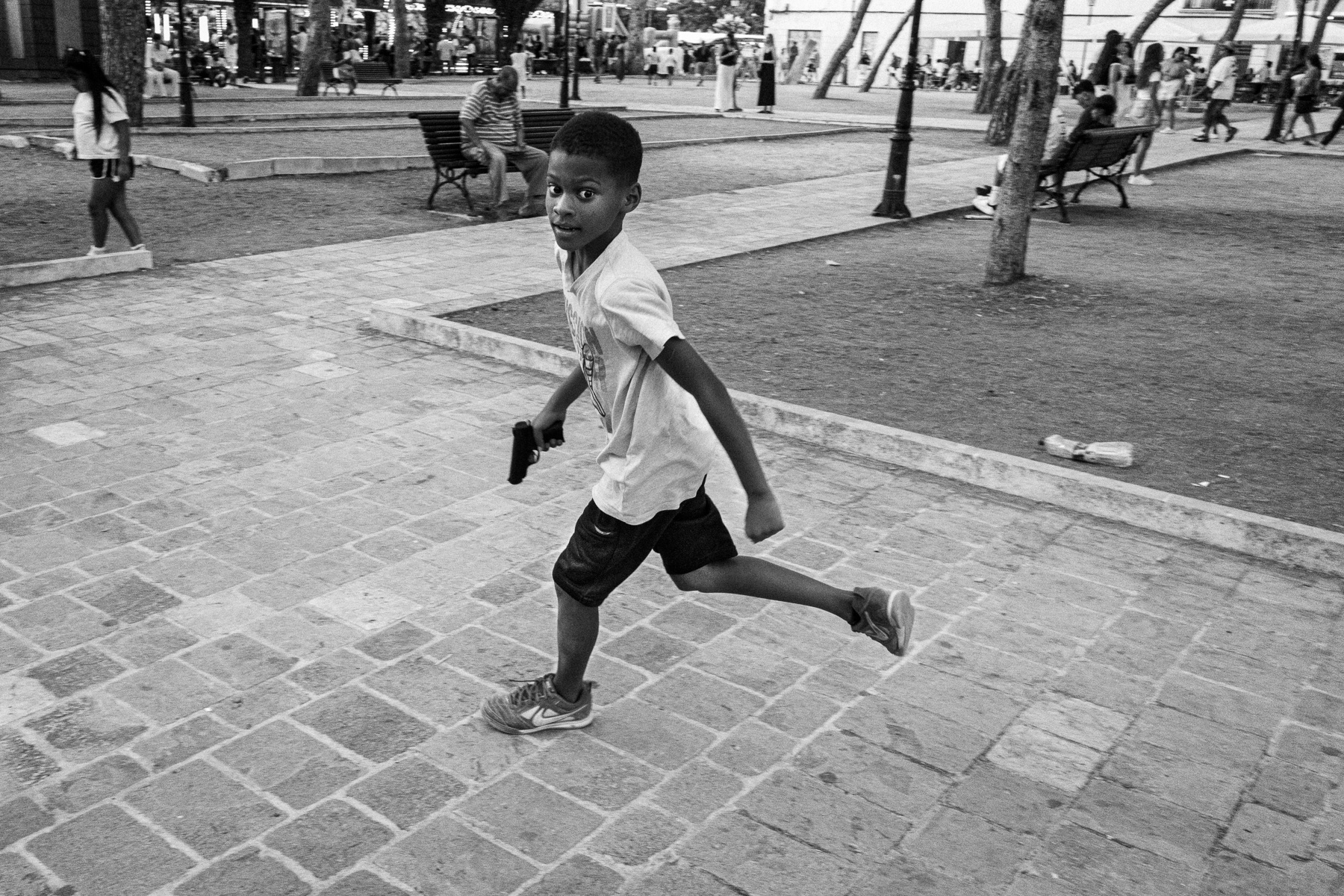
Sant Joan does not need more spectacle. It already has enough.
What interested me was the pressure around it: bodies packed into narrow streets, hands looking for balance, the animal becoming public weather, the crowd pretending it can control what it has summoned.
The horse is not always the subject. Sometimes the subject is the space it removes from everyone else. The bent neck, the raised legs, the hands against the wall, the phone too close, the face half-hidden by heat and noise. The ritual holds because it nearly stops holding. That edge is where these photographs sit.
Ciutadella gives the event a beautiful frame. These photographs do not obey that frame for long. They stay closer to the crush, the sweat, the uniform, the balcony, the interior rooms before the street swallows everything again.
Black and white strips away the festive explanation and leaves weight: skin, stone, cloth, shadow, animal muscle, public fatigue.
This is not a guide to Sant Joan.
It is a first edit from inside the pressure.
Technical note: Sant Joan de Ciutadella, 2026. Black and white street photography. Leica M10 Monochrom / Ricoh GR IV Monochrome · Lightroom Classic.
Original shot by StreetSoul with my loved Ricoh GR IV Monochrome and Lightroom Classic.
Review of Disparos contados, by Leila Méndez
The finger arrives too soon.
That is the problem, or at least one of the problems. Digital photography did not invent haste, but it gave it batteries, a screen, cheap memory, and a very convenient technical excuse. Shoot now. Think later. The phrase sounds practical until one day you open the archive and find hundreds of correct, polite, sharp, perfectly dead images. A cemetery can also be well focused.
Disparos contados, by Leila Méndez, enters through this crack. Not through the solemn door of analogue nostalgia, with its smell of darkroom, leather straps, and people talking about “process” as if they had discovered wet fire. The book looks at something smaller and more useful: restraint. The pause before the click. The discomfort of knowing that not everything deserves to be photographed just because it can be photographed.
Its strongest idea is not to defend film against the sensor. That war has already produced enough dull conversations on terraces, forums, and dinners where someone always ends up saying “texture” with worrying gravity. Méndez points toward an attitude. Photograph with fewer automatisms. Accept a little friction. Let the image take longer to arrive, even if that delay looks bad in any productivity metric.
In the excerpt published by Anagrama, there is a perfect scene for understanding the book: a concert photographer who loaded his roll of film at the beginning, spent most of the concert watching, and only took three photographs at the end, at the moment of highest intensity. Three. Not one more. The restriction did not make him better by magic, but it forced him to wait for something. And waiting, in photography, is already almost a form of thought.
This is where the book gains weight. Analogue photography does not appear as a superior purity. Méndez herself warns that the chemical format does not improve or elevate any artistic discourse by itself. Good news: film does not redeem mediocrity either. An empty photograph remains empty, even if it has grain and cost twelve euros to develop. Grain can hide many things, but it does not perform miracles. No point asking it to do saintly work.
What analogue does offer, when it does not turn into theatre, is a useful kind of poverty. Few exposures. Cost. Delay. Uncertainty. A chain of small irritations that force you to decide before producing. Digital, by contrast, has trained us to produce before deciding. We will choose later. We will edit later. We will see later. That “later” piles up on hard drives full of images that do not ask to be looked at, only archived with a moderate sense of guilt.
For StreetSoul, the book touches a familiar nerve. Street photography has always lived too close to hunting. A body crosses a shadow, a hand slips out of a shop window, a face is cut by a reflection, the traffic light stages a little involuntary theatre. The finger wants to shoot. The street does not wait. But haste is not always instinct. Often it is only the fear of going home without prey.
Méndez is not asking us to go backwards. That saves the book from a very easy fall. In photography, the past usually has too many defenders with display cabinets. The interesting question is not whether we should return to film, but what we can learn from that imposed slowness. What happens if a digital camera is used with a less greedy discipline. What changes if the photographer accepts not shooting. Not out of Zen posturing, that other plague with good natural light, but out of respect for the image.
Immediacy has turned many photographers into administrators of their own noise. Go out, shoot, import, select, edit, export, publish, tag, measure, repeat. A flawless chain. Also a slightly idiotic one. Photography ends up working shifts to feed platforms that confuse presence with meaning. The world was already saturated enough before every shadow had to book an appointment with Instagram.
Disparos contados matters when it defends a simple idea without turning it into doctrine: limits can sharpen the eye. They guarantee nothing. They do not make anyone a better photographer. They only remove excuses. With fewer shots, each shot weighs more. With less abundance, the decision stands more exposed. And when the decision is poor, it can no longer hide behind a burst.
The book should also be read against another superstition: the belief that an analogue attitude carries some kind of moral nobility. It does not. It can mean judgement, patience, waiting. It can also mean vanity with developing receipts. The format is not what makes the difference. The eye does. A digital Leica can be as lazy as a plastic compact. A roll of film can contain thirty-six expensive mistakes. Chemistry does not think for anyone.
The book’s value sits in this uncomfortable zone: it does not sell a solution, it points to a vice. We shoot too much because we can. We look too little because looking does not immediately produce anything. Photography, when it still keeps a little dignity, begins just before the click. In that small second when the finger shuts up and the mind, if it gets there in time, decides.
The problem is not coming home with few photographs. The problem is coming home with a thousand and discovering that none of them had been waited for.
You can buy this book here with 5% discount and free shipping.