Author: StreetSoul

  • Feeding Time

    Feeding Time

    A horse eats from a bucket. The pigeons close in. People pass, wait, work, disappear into the background.

    Nothing dramatic. Just the city dividing up a few square metres of pavement according to rules nobody wrote down.

    The horse gets fed. The pigeons steal what they can. The humans keep moving.

    Leica M10 Monochrom · Elmarit-M 28mm f/2.8 ASPH.

    From series Urban Wildlife.

  • Before / After: Bringing Him Back

    Before / After: Bringing Him Back

    The original was too dark. The face was almost gone, the shirt was flat and the harbour pulled the eye away. I opened the shadows, lowered the background a little, cropped tighter and added some grain. Nothing clever. Just putting the photograph where it should have been.

    And that little Brightin Star 28mm f/2.8… bloody hell. It is tiny, cheap and far better than it has any right to be. Sharp, but not sterile. Good contrast, lovely grey tones and a bit of character around the edges. I bought it out of curiosity. It keeps giving me reasons to use it.

    Leica M10 Monochrom · Brightin Star 28mm f/2.8

    Before / after editing
  • The People Were Part of the Show

    The People Were Part of the Show

    At an opening, the paintings stay on the walls and people do what people do: talk too much, block the way, glance sideways and occasionally remember to look properly.

    At Enrique Mestre’s exhibition, the room had more layers than expected. The paintings, obviously. But also faces close to the frames, gestures left hanging in mid-conversation, a dog moving under everyone’s legs and Enrique himself, briefly caught inside the scene.

    I went in with the Leica and a 35 mm, close enough to be slightly in the way. The opening carried on around me: late arrivals, someone leaning too near a painting, someone else already thinking about the next drink. The work stayed on the walls and took it.

    That was what I photographed. The small friction between the art and the people looking at it. Or pretending to.

    Technical: Leica M10 Monochrom · Summicron-M 35mm f/2

  • No Appointment Needed

    No Appointment Needed

    He was sitting outside an orthopaedic clinic with the relaxed authority of someone who had no intention of being repaired. I asked for a portrait. He gave me a minute and barely changed his posture—which was fortunate, because the posture was already doing most of the work.

    The background is busy: parked car, tree, signs, promises of treatment. None of it is elegant, but elegance is frequently just reality after an expensive cleaning. Here, the surroundings locate the man in the world and provide their own accidental diagnosis.

    Photographed with the Ricoh GR IV Monochrome.

    Series: Portraits

  • A Monday That Turned Out Better Than Expected

    A Monday That Turned Out Better Than Expected

    One of my recent photographs has been selected by Progressive Street as photo of the week.

    And yes, I am very happy about it. Happier than is probably dignified to admit in public.

    It is the image of the boy running with a toy gun in his hand. A quick scene, almost caught out of the corner of the eye: the body in motion, the arm lowered, the direct look into the camera. I did not have much time to think. Better that way, probably. Had I thought too much, I would have missed it.

    What I especially liked is the text that accompanies the selection. It does not settle for the easy reading. It talks about play, childhood aggression, and the difference between a toy gun and real violence. But it also lets in that unavoidable unease: in some places, children do not play at war. They are dragged into it.

    That ambiguity is, for me, what holds the photograph together. I do not know whether it is innocent, unsettling, or simply something that happened in front of me for half a second. Maybe all of it at once. The street does not ask permission to be contradictory.

    Seeing it published by Progressive Street already made my day. Seeing it placed, even loosely, in conversation with photographs by William Klein and Diane Arbus is slightly dizzying. I am not going to pretend I belong at that height, because I still have a little shame left. But having one of my photographs read in that visual territory is a gift. A big one.

    Thank you to Progressive Street and Batseba Hardy for looking at this image with such care.

    Now I will pretend I have not refreshed the page too many times.

    Leica M10 Monochrom · Lomography Atoll Ultra-Wide 17mm f/2.8

    More Small Dramas here.

  • Liberty Takes Quarters

    Liberty Takes Quarters

    On Liberty Island, three coin-operated viewers stand in line before a horizon that was already free.

    The nearest one has all the authority: metal face, twin eyes and a small order stamped across its mouth: QUARTERS ONLY. Then a seagull crosses the frame without paying, without focusing and apparently without feeling any need to improve the view.

    The 17mm exaggerates the distance between the machines and turns the closest one into something halfway between street furniture and a minor government official. The bird arrived late and saved the photograph. Without it, this might have been a very tidy architectural exercise. A terrible fate.

    Technical: Leica M10 Monochrom · Lomography Atoll Ultra-Wide 17mm f/2.8.

    More Absurd World here.

    Before and after editing.
  • Second Opinion

    Second Opinion

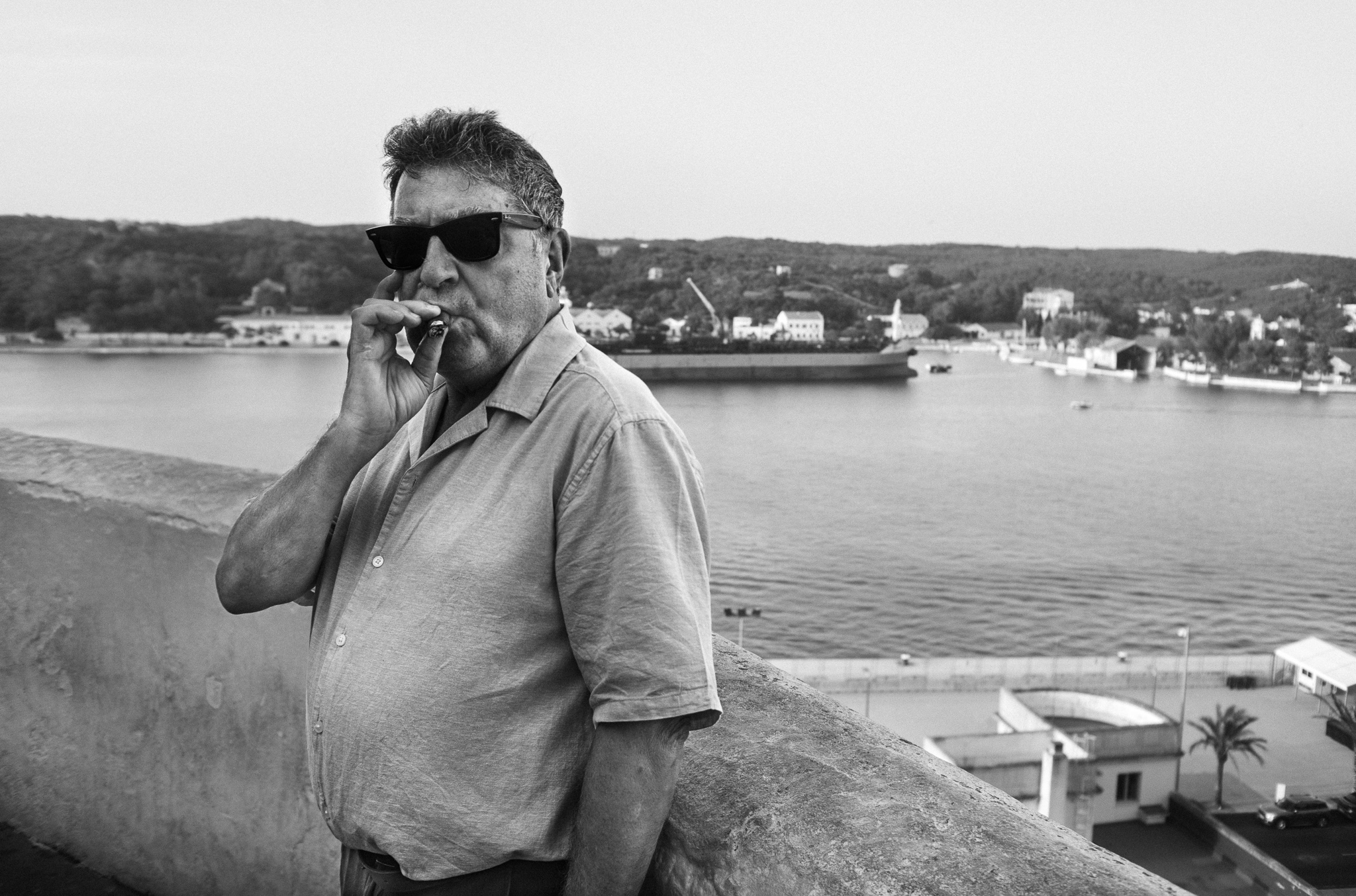
    There is a trace of Absurd World here, but I would not file it twice. The man carries the photograph. The absurd part arrives later, over his shoulder, disguised as a backpack with a face.

    He looks straight at the camera. Cigarette against his chest, watch, rings, no attempt to disappear. That is where the picture holds. Then you notice the cartoon face behind him and the frame shifts slightly. Not into a joke. Just somewhere stranger.

    Technical: Leica M10 Monochrom · Leica Summicron-M 35mm f/2.

    More Portraits here.

    Before and after editing.
  • Soft Target

    Soft Target

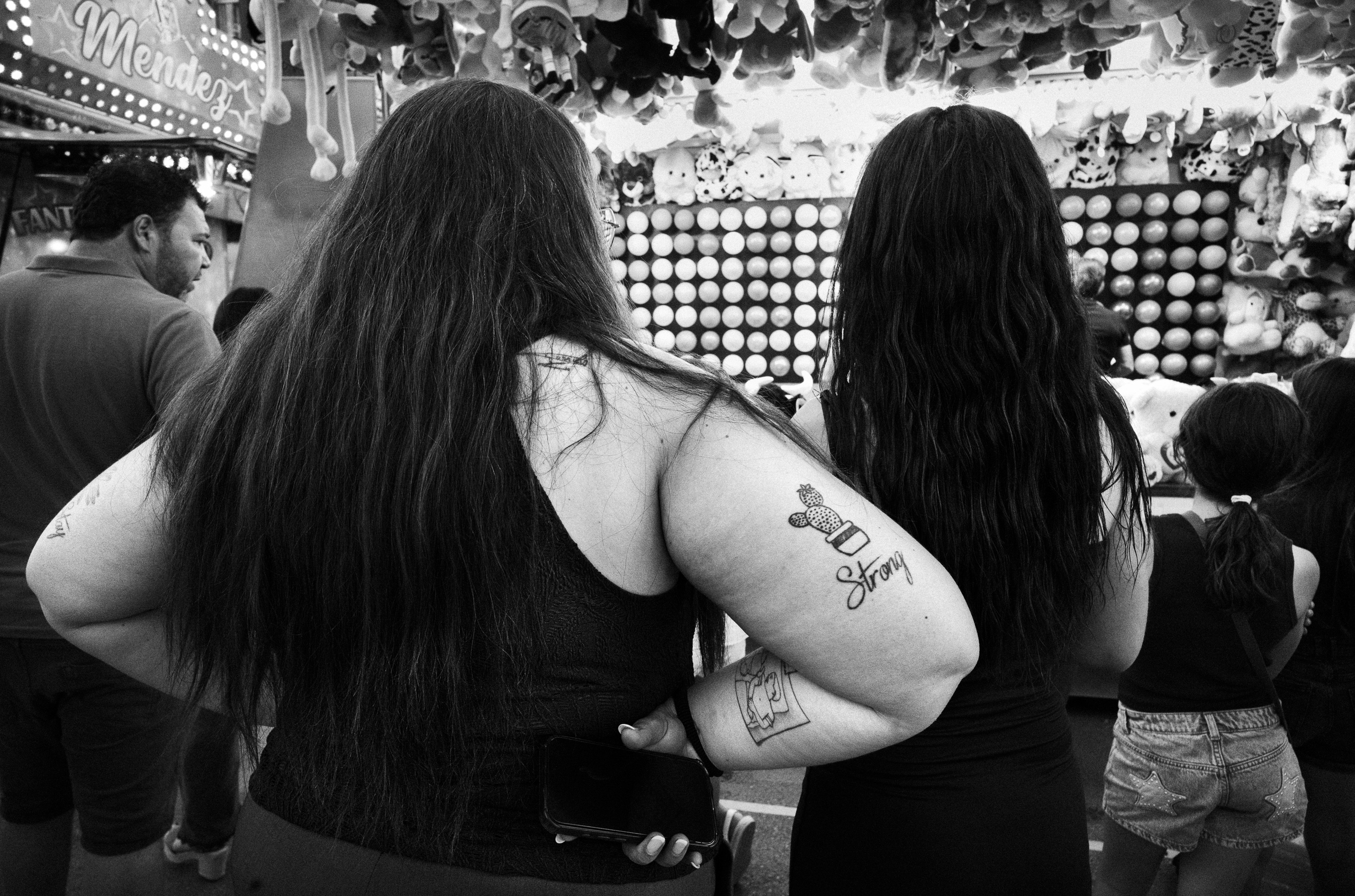
    Fairground stalls do not leave much room for looking properly. Lights, stuffed prizes, rows of white targets, people drifting in and out. Too much of everything.

    What held me was the arm.

    The woman on the left had Strong tattooed under a small cactus. A detail almost too convenient, honestly. The kind of thing that can hijack a photograph if you let it. But the gesture beside it was better: her arm around the other woman, the phone dangling behind her back as if she had forgotten it was there.

    I left the man on the left and the child on the right. They crowd the frame and make it slightly harder to read. That helped. Without them, the image becomes cleaner, more private and probably weaker. The 21mm kept everyone inside the same mess: lights, prizes, targets, bodies, waiting.

    The top of the stall is close to blowing out. The lower half nearly disappears into hair and black clothes. I could have fixed that a little. I did not. The imbalance felt right.

    The tattoo gave me the easy title. I went elsewhere. Soft Target felt less tidy, which was the point. Strength on the skin, a quiet gesture, all those targets behind them.

    Technical: Leica M10 Monochrom · Thypoch Ksana 21mm f/3.5 Asph.

    Before and after editing.
  • No Further Questions

    No Further Questions

    The picture was already there. Mostly.

    The first file was not bad. That was the awkward part. Nothing obvious needed fixing. The face was clear, the pose worked, and the background stayed more or less where it belonged. Still, everything spoke at roughly the same volume. The shoulder, the face, the space behind her. All very polite.

    The photograph is not really about the pose, though. The pose is easy. The look is not.

    She rests her head on one hand. There is a small smile, almost as if the whole situation amuses her. But the eyes hold something back. They look straight at the camera without quite giving in to it.

    That tension was already in the file. The edit just had to stop getting in the way.

    I darkened the background. Not much at first, then a little more. The hair needed weight, and so did the black top. Once those areas settled, the face began to sit where it should. Not floating. Not glowing. Just there.

    I pulled back some of the brighter skin tones too, mainly on the shoulder and forehead. They were not blown out, but they caught the eye too soon. A small adjustment around the eyes and hand was enough. More than that and the photograph started to look edited, which is usually a warning. Editing that asks to be admired has probably gone too far.

    The Nokton had already given the image enough softness, so I left most of it alone. No porcelain skin. No heroic sharpening. A face is allowed to remain a face.

    The finished version is darker, but that is not really the point. The photograph now knows where to look.

    The hair holds the right side of the frame. The hand joins the head to the body. The background finally shuts up. What remains is the slight disagreement between the smile and the eyes.

    She looks comfortable.

    I am not entirely sure she is.

    Technical note
    Leica M10 Monochrom · Voigtländer Nokton 50mm f/1.5

    Before and after editing
  • Plastic Karma

    Plastic Karma

    Enlightenment arrived by compressor.

    A colossal figure has settled in the middle of an ordinary street. Eyes closed. Palms open. Expression beyond complaint. Behind it: tired render, garage doors, utility boxes, a streetlamp and wires crossing the sky with the usual civic indifference.

    The figure offers serenity, but the seams are visible. So are the cords. Transcendence, apparently, requires anchoring points.

    This is where Plastic Karma begins: not with plastic as rubbish, but with plastic as belief. A temporary deity, light enough to be folded, transported and stored after use. The sacred has become inflatable—not destroyed, merely made practical. There is probably a compressor somewhere outside the frame doing the real spiritual work.

    The ultra-wide view gives the figure nowhere to hide. It fills the street and still belongs to it. The raised hands almost touch the surrounding houses; the elaborate crown rises into the web of cables. Monument and neighbourhood collide without ceremony. One was built to astonish. The other has seen invoices.

    At ground level, a small weighted anchor sits beside the immense body, an undignified detail that improves everything. Every vision needs ballast. Every god needs somebody to stop it rolling down the road.

    The face remains composed.

    Plastic is good at that.The goddess arrived folded.

    By the time I found her, she had taken possession of the street: a vast inflatable woman with closed eyes and open hands, wedged between garage doors, rough plaster and domestic wiring. The houses looked older for having her there. She looked cheaper.

    Her expression has the irritating serenity of things that never have to pay for themselves. The crown rises into the cables. Her elbows nearly touch the walls. Thin ropes hold her body in place, and beside one foot sits a small weight—the practical detail that ruins the miracle and makes the photograph.

    The 17mm lens leaves no room for respectful distance. She swells towards the frame while the street presses back: a lamp, a balcony, corrugated roofing, the number five above a dark doorway. Nothing has been prepared for revelation. Someone has simply inflated it between the usual routines.

    That is the useful tension. The figure is too large to ignore and too obviously temporary to believe in. She may be a goddess, an advertisement, festival decoration, or all three. Faith with a valve. Grandeur delivered by van and packed away before Monday.

    The face keeps its composure. The stitching runs down the cheeks and chin. Air holds everything together.

    For now.More shots in Absurd World.

    Technical: Leica M10 Monochrom · Atoll Ultra-Wide 17mm f2.8.