Category: Uncategorized

  • Turning Bad Weather Into Photographs

    Turning Bad Weather Into Photographs

    Daily writing prompt
    What strategies do you use to cope with negative feelings?

    Negative feelings have terrible timing. They appear when you are tired, uncertain, or already carrying too much, then behave as if they have arrived to reveal some profound truth. Anxiety says everything is about to collapse. Doubt suggests your work is thinner than you hoped. Frustration, never shy, declares the whole effort ridiculous.

    They are persuasive, but they are not wise.

    What I have learned is that negative feelings are easier to live with when I stop treating them like verdicts and start treating them like raw material. Left alone, they spread. Given a form, they become manageable.

    That is one reason I trust street photography. Going out with a camera pulls me out of the swamp of self-absorption and back into the strange theatre of the world. The city does not care about my mood, which is oddly helpful. It keeps moving. Light slides across a wall. Someone hesitates at a crossing. A gesture appears and disappears in a second. If I pay attention, my feelings stop being the centre of the universe and become just one element in a larger scene.

    Photography does not cure anything, of course. Life is rarely so obliging. But it does something better: it redirects the mind. Melancholy becomes attention. Restlessness becomes patience. Irritation sharpens the eye. The feeling is still there, but now it has a task. It has somewhere to go besides chewing the furniture of the mind.

    Making things helps for the same reason. Writing helps. Editing helps. Building a small body of work helps. Negative emotion is often just energy with no discipline. The trick is not to deny it, and not to worship it either, but to put it to work. A sentence can hold what would otherwise become noise. An image can absorb a mood and return it in a form you can actually look at.

    Routine matters more than inspiration, irritating though that may be. A regular practice gives the mind fewer opportunities for melodrama. Sit down. Choose the frame. Edit the work. Write the note. Keep going. The ritual is modest, almost boring, which is precisely why it works. It replaces rumination with movement. It turns weather into rhythm.

    Perspective helps too. Negative feelings are expert counterfeiters: they take one difficult hour and try to pass it off as a whole identity. But a bad moment is not a final truth. A mood is not a philosophy. It is only weather passing through.

    So I cope, mostly, by moving toward attention rather than away from discomfort. I walk. I watch. I wait. I make something. Not because this defeats darkness once and for all (what a glorious piece of nonsense that would be), but because it gives darkness less empty space in which to perform.

    And sometimes that is enough: a street, a camera, a fragment of light, and the brief relief of having turned feeling into form.

    Technical: Leica M10 Monochrom + Leica Elmarit-M 1:2.8/28 ASPH.

    Series: Urban Wildlife.

  • Letter to My 100-Year-Old Self

    Letter to My 100-Year-Old Self

    Daily writing prompt
    Write a letter to your 100-year-old self.

    Dear old animal,

    If this letter has reached you, two things are true. First, you have managed the astonishing trick of not dying for quite a while. Second, you are now old enough to make everyone else in the room look like a rushed draft.

    I do not know where you are when you read this. Maybe in a quiet apartment with good window light. Maybe near the sea. Maybe in a chair that has finally learned the shape of your stubborn back. I hope there is coffee nearby. I hope there is a camera nearby too, even if your hands now take their time negotiating with buttons and dials.

    I am writing to you from the age where a man still mistakes motion for progress every now and then. I still feel the itch to do more, publish more, prove more, build more. The modern disease, really. Dress it up with ambition and discipline if you like, but half the time it is just fear wearing a respectable jacket.

    So tell me: did you ever finally learn the difference between making work and performing the idea of being a person who makes work?

    I hope you did.

    I hope that by one hundred, you no longer confuse applause with meaning. I hope you remember that the best things you ever made were rarely born from speed, vanity, or strategy. They came from attention. From standing still longer than other people. From noticing the absurd little theater of the street. From understanding that a face in hard light, a hand in mid-gesture, a cheap joke of coincidence between bodies and billboards could hold more truth than most speeches ever will.

    I hope you are still looking carefully. That is what I really mean.

    Not productivity. Not legacy. Not “content,” that miserable little word. Looking. The old human miracle of actually seeing what is in front of you before the mind barges in and starts naming it badly.

    Did you keep your sense of humor? I need that to be yes. Because without it, age becomes ceremony, and ceremony is often just ego in orthopedic shoes. I hope you still laugh at pompous people, especially if one of them is you. I hope you still distrust certainty when it arrives too neatly. I hope you never became one of those solemn statues who confuse seriousness with wisdom. The world is too strange for that. Too funny. Too cruel, yes, but also too gloriously ridiculous.

    I hope you became gentler without becoming softer in the head.

    That matters to me. I do not want you kind in the empty, decorative sense. I want you precise. I want you able to tell the truth without using it as a hammer. I want you to have learned that most people are carrying invisible weather, and that patience is not passivity but discipline. I want you to remember that everyone is improvising, including the ones pretending to be authorities. Especially them, in fact. The universe has always been held together with string, luck, and paperwork.

    Did you make peace with unfinished things?

    There are so many already. Photos not edited. Essays not written. Ideas half-built. Projects that looked important until life walked in and rearranged the furniture. I would like to think that by your age you no longer see incompletion as failure. Maybe it is just the natural state of any honest life. A life fully tied up in a bow would be suspicious. It would mean you stopped reaching too early.

    I also hope you forgave yourself for the years spent waiting for permission that was never coming.

    Permission from whom, exactly? The gatekeepers? The crowd? The imaginary tribunal of polished mediocrities? What a circus. I hope by now you know that most doors are not guarded by dragons but by boredom. You knock, nobody answers, and eventually you realize you were allowed to enter the whole time.

    Tell me you loved people well. Not perfectly. Perfectly is for bad novels and dictators. But well. With loyalty. With curiosity. With time. Tell me the people who mattered knew it. Tell me you did not hide behind work when life asked for tenderness. Tell me you said the difficult things while there was still time for them to matter.

    And tell me this too: did you remain interested?

    That may be the whole game. Not success. Not reputation. Interest. The stubborn refusal to become spiritually upholstered. The appetite to keep learning one more thing, reading one more page, walking one more street, asking one more dangerous question. I can forgive you for almost anything except becoming dull to the mystery of being here at all.

    If your body is tired now, I understand. Bodies are loyal servants and terrible long-term investments. They carry us heroically and then start charging absurd maintenance fees. But I hope your mind still wanders with style. I hope some spark in you still rises at a shaft of light on a wall, a sentence with teeth, a stranger with a magnificent face, a small act of decency in a world often drunk on noise.

    Maybe that is enough. More than enough, actually.

    I will not ask whether you became “successful.” That word has always smelled faintly of office carpet. I will ask whether you stayed awake. Whether you kept faith with your eye, your voice, your standards. Whether you learned to waste less time on nonsense and more on the rare things that make a life feel inhabited from the inside.

    If you can still walk, go out for a little while. Look at people. Look at the light. See what survives.

    And if there is no camera anymore, use your eyes like the first instrument they always were.

    With affection, impatience, and a certain amount of suspicion,

    Your younger self.

  • The last thing I learned is that attention is not the same thing as direction

    The last thing I learned is that attention is not the same thing as direction

    Daily writing prompt
    What is the last thing you learned?

    For a long time, I treated the internet like a slot machine for photographers: post the image, pull the lever, wait for the little dopamine lights to blink. Sometimes they did. A few likes, a nice comment, the brief and flattering illusion that something was “moving.” But most of it went nowhere. Not because the work meant nothing, but because I was asking scattered images to do the job of a body of work.

    That was the lesson.

    A photograph can stop someone for a second. A series can make them stay. A website can make them understand what you are doing. And a clear path — one honest page, one coherent voice, one place to start — can turn random attention into something with shape. Strange concept, I know: structure. The great enemy of romantic chaos.

    I used to think visibility was mostly about posting more. More frequency, more platforms, more noise. Very modern. Very efficient. Very stupid. What I’m learning now is that visibility is closer to architecture than performance. People do not need ten doors. They need one door that is open.

    That changes how I look at my own work.

    Now I’m less interested in whether one frame gets applause and more interested in whether it belongs to something larger. Whether it speaks the same language as the next image. Whether the person who arrives can feel a mind behind the photographs, not just a habit of uploading.

    So yes, the last thing I learned was simple: more attention is not always better. Better structure is better.

    Infuriatingly, that may be actual progress.


    Technical: Leica M10 Monochrom + Elmarit-M 1:2.8/28 ASPH.

    Series: Urban Wildlife.

  • The Question I Hate Most

    The Question I Hate Most

    Daily writing prompt
    What is one question you hate to be asked? Explain.

    One question I especially hate being asked is: “How much is the camera you use?”

    Not “What camera is it?” Not “Why do you use that one?” Not even “What do you like about it?” Those can lead somewhere interesting. But the price question usually lands with all the grace of a brick through a window.

    Because the moment the conversation starts with cost, the photograph is already in danger of disappearing.

    The image could have tension, wit, tenderness, absurdity, loneliness, or that rare little shock of real life revealing itself for half a second. But instead of looking at any of that, we jump straight to the market value of the object that happened to be in my hands. It is such a wonderfully modern reflex: faced with something human, we ask for the invoice.

    And yes, cameras matter. I am not going to do that fake-pure artist routine where tools are irrelevant and we all become saints with shutters. Tools matter. They affect how you move, how you frame, how quickly you react, how visible you are, how much trust you place in the machine. But the price of the camera tells you almost nothing about the quality of the photograph. It mostly tells you how easy it is for people to confuse cost with vision.

    That is the part that irritates me.

    The question often carries a hidden theory: if the camera is expensive enough, maybe the image is partly purchased. As if photographs were luxury goods produced automatically by premium machinery. As if the hard part were not seeing, waiting, choosing, failing, missing, returning, and developing an eye over years of paying attention. No, apparently the secret is just financial pain with a leather strap.

    Street photography is especially brutal with this illusion. The street does not care what your camera costs. It will still give you bad timing, ugly light, cluttered backgrounds, awkward distances, blocked frames, and all the indifferent chaos it can throw at you. An expensive camera does not grant wisdom. It just gives your mistakes higher manufacturing standards.

    What annoys me most is that the question reduces photography to consumption. It turns a way of seeing into a shopping category. The real story is almost never the price of the tool. The real story is why I stopped there, why I waited, why I included one person and excluded another, why I chose black and white, why that tiny gesture mattered, why that moment deserved not to vanish unnoticed.

    So when someone asks me what my camera costs, I can answer with a number. But the more honest answer is that the expensive part was never the camera. The expensive part was time: the years of looking, doubting, missing, learning, and slowly becoming less blind.


    Technical: Yashita Mat 124G + Ilford FP4.

  • I Didn’t Need More Likes. I Needed a Door

    I Didn’t Need More Likes. I Needed a Door

    Daily writing prompt
    How has a failure, or apparent failure, set you up for later success?

    For a long time I confused “having an online presence” with “taking photos and posting them.” That’s it. As if the universe owed me an audience just because I also shoot black and white, have a Leica M, and hold strong opinions about contrast. Spoiler: it doesn’t owe you anything.

    My “failure” wasn’t some spectacular wipeout. It was much more embarrassing: the sum of small, scattered decisions that made the whole thing go nowhere. I posted when I could, on different platforms, with bios that didn’t tell quite the same story, with links that kept changing, and with a website that didn’t turn curiosity into anything concrete (no contact, no follow, no “ah, this person has a point of view”). It was like putting on an exhibition and forgetting to add a door.

    The worst part is that, on the surface, it didn’t look like a disaster: there were likes, a comment here and there, the occasional dopamine spike. But it was the kind of “success” that didn’t accumulate. A stream. And a stream, if you don’t channel it, goes straight down the drain.

    That’s what set me up for the kind of success that isn’t sexy but actually works: accepting that I needed a system, not inspiration. I went from “posting whenever it suits me” to a short but fixed weekly routine, separating production (selection, editing, export, and text) from distribution and community (batch posting, commenting with intent, and minimally measuring what happens). It’s literally building a machine so your energy doesn’t get wasted arguing with your calendar every week.

    And the key change wasn’t posting more. It was posting in a more connected way.

    I realized a single photo is a spark; a series is a piece people can remember and share. That’s why I started thinking in terms of series pages on the website, a “Start here” that explains in five seconds what I do and where to go next, and the unglamorous but decisive details like descriptive alt text (yes, writing what’s in the photo, like a functioning adult) so the site isn’t just a silent display case.

    It also forced me to be honest about my narrative. If I shoot street in monochrome with an M10 Monochrom and also with film, the homepage can’t sound like I’m “film-only” one day and “digital-only” the next. Consistency isn’t about pleasing people: it’s so nobody has to solve a puzzle just to understand you.

    The funniest part is that this “failure” made me a better photographer, not just a better poster. When you have a system, you quickly notice which images hold up to a second look (the ones that can carry a series) and which ones only work as fast sugar. And that changes how you edit, how you select, and even how you wait on the street: you stop hunting for “one good photo” and start hunting for an idea with legs.

    In the end, the failure was believing the world would find my work; success started when I made finding it easy… and gave people a reason to stay.

    The city doesn’t owe you attention; but it hands you scenes every day, and that’s already plenty.

    Technical: Horizon S3 Pro.

  • The Weight of a Quiet Moment

    The Weight of a Quiet Moment

    This portrait hits that rare sweet spot where nothing is trying too hard, and that’s exactly why it works. The man isn’t performing for the camera. He’s just… there. Present, guarded, thoughtful, slightly tired of the world’s nonsense. The expression feels like a whole biography compressed into a pause. Street portraits usually die the moment the subject “poses”; here, the honesty survives.

    The brand new 21mm Thypoch is a big part of the magic (and the risk). A 21mm doesn’t flatter people; it tells the truth loudly. To make it work you have to get close, close enough that the photo becomes a social contract, not just a capture. That closeness gives the portrait its intimacy, while the wide field keeps the environment speaking: the booth’s buttoned upholstery, the window light, the soft geometry behind him. You get a face and a place, without turning the background into noisy trivia.

    With a Leica M10 Monochrom, this scene becomes about structure instead of decoration. The tonal separation in his skin, the sweater’s texture, the leather’s sheen… monochrome turns all of that into readable substance. The light is gentle but directional: it models the forehead lines, the cheekbones, the quiet tension around the mouth. The glasses add a second frame inside the frame, and the reflections stay controlled enough to keep the eyes alive, always the real subject.

    Compositionally, it’s disciplined in a way that looks effortless (the best kind of discipline). He’s slightly off-center, looking past the lens, which creates narrative space, like the photo is mid-thought. The booth anchors him, the windows open the world behind him, and the wide angle exaggerates just enough perspective to feel immersive without turning him into a caricature. It’s a portrait that respects distance while being made from up close. Contradictory, human, and therefore accurate.

    Technical: Leica M10 Monochrom + Thypoch Ksana 1.3.5/21 ASPH.

    Series: Portraits.

  • Living the Dream (Next to the Trash Bins)

    Living the Dream (Next to the Trash Bins)

    Times Square is basically a factory that mass-produces attention. So when someone sits down right in the middle of it calm, amused, smoking like the chaos is background music, it feels almost rude (in the best way).

    My main decision was to simplify the noise: I framed her against the shipping container so the scene has one big, blunt shape instead of a thousand tiny distractions. The container becomes a deadpan backdrop, and the “TIMES SQUARE” bins do the unglamorous job of pinning the place and adding a little irony: the world’s loudest square, reduced to municipal typography.

    I waited for that half-smile and hand-to-mouth gesture (something between “caught” and “I don’t care”). The passersby on the right stay as proof that this is public theatre, and most people are walking past the best scene.

    Technical: Leica M10 Monochrom + Elmarit-M 1:2.8/28 ASPH.

  • Ancient Marble, Modern Middleware

    Ancient Marble, Modern Middleware

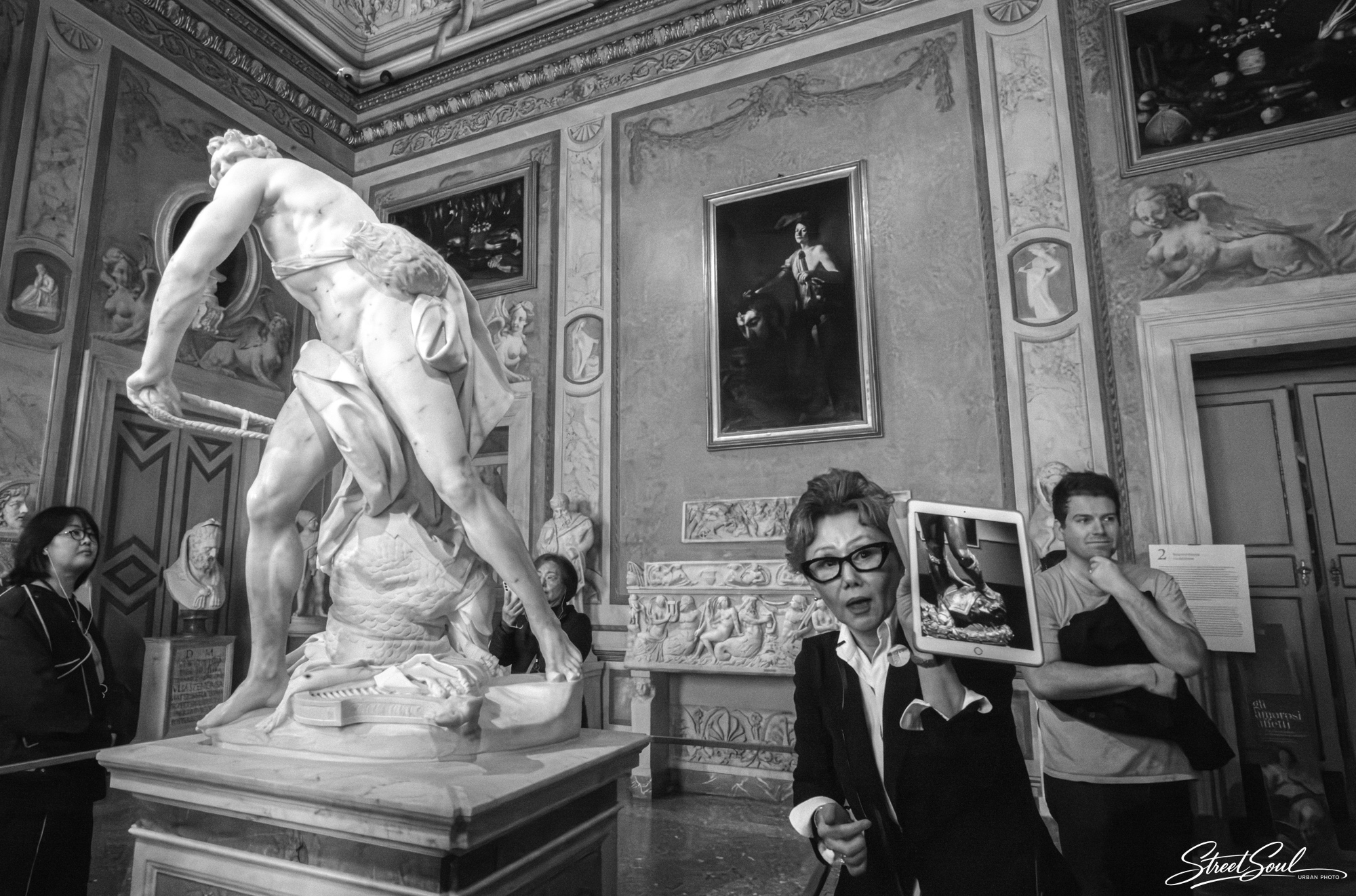
    Galleria Borghese: marble biblic hero mid-swing, ceiling doing its Baroque flex, and us, tiny, politely fenced mammals, trying to “experience” it through a slab of glass. I waited for the guide to raise the tablet, not because I love screens, but because it turns the room into a time loop: sculpture, then its almost pixel double, then the human face caught between both. Even the guy on the right is doing the classic museum pose: chin-on-fist, pretending the wall text is philosophy.

    Composition decision: I pushed the statue hard to the left and let the wide room breathe so the people feel like annotations, not protagonists. The tablet becomes the punctuation mark.

    Technical: Leica M10 Monochrom + Atoll 1:2.8/17.

    Series: Urban Wildlife