
Fotografías de guerra (1974-1985) arrives with dust, iron, and a white light that hurts the eyes. The book demands a steady stomach, a still gaze, and very little faith in grand words.
On the cover, an armed man aims at an empty horizon. His body carries the tension: the bent back, the long rifle, the pale clothes, the desert ahead. War is reduced to a posture. A way of crouching. A way of waiting for something worse to happen.
The selected photographs have a dryness that works in their favour. There is grain, dust, walls scorched by the sun, sweaty clothes, weapons that weigh too much, and bodies settled into an almost physical discomfort. War, seen like this, sheds rhetoric and gathers dirt. It also gathers weight. The exact weight of a weapon, of a pocked wall, of a man crouched for too long under a light that flattens everything.

One of the hardest images is that of the fighter running with the rifle across his back. The body is caught mid-thrust, low, almost animal. The violence comes from the movement, from the dust, from that slightly ridiculous urgency of running with death slung over your back. War puts men into absurd postures and then asks them to call it heroism. Humanity, once organised, produces admirable documents and massacres with logistics.

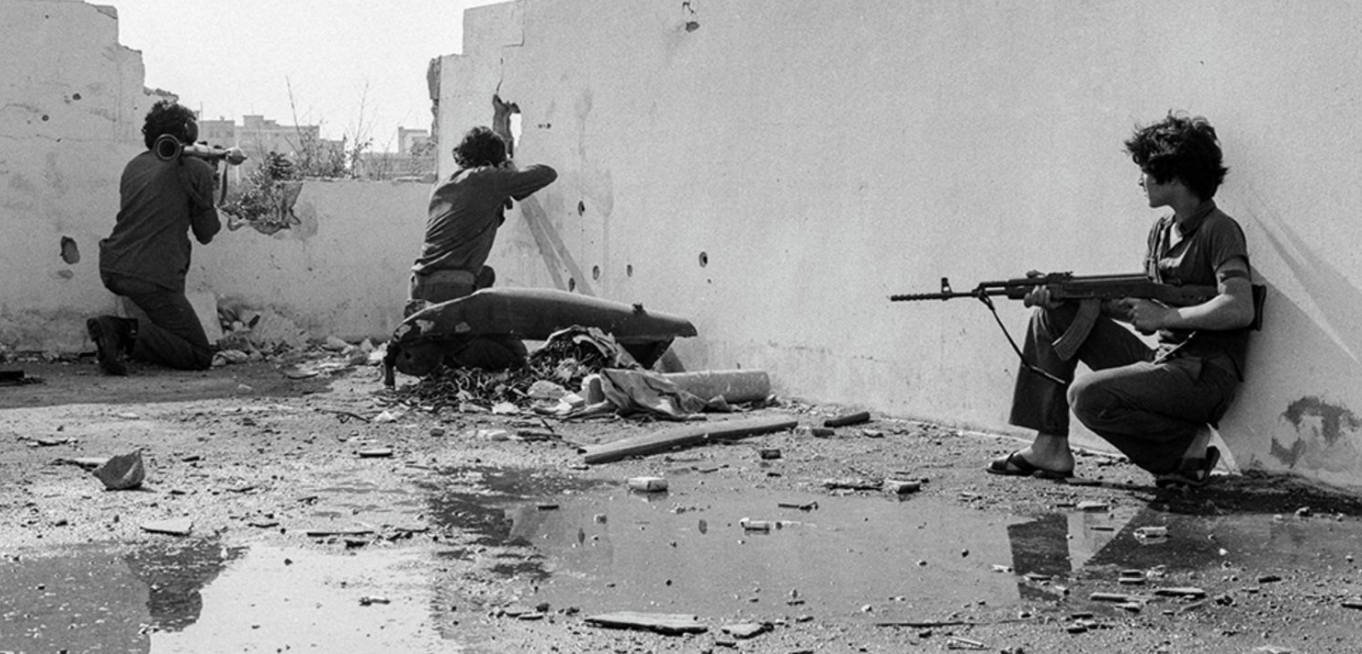
In another scene, three figures occupy a terrace or a half-ruined space. On the left, a man aims. In the centre, another throws something against a white wall covered in marks. On the right, a young woman waits with her rifle horizontal, crouched, too still for what is happening around her. The floor is filthy: rubble, puddles, scattered fragments. The wall ends up ruling the image. White, dry, punctured. A punished surface that seems more alive than the people hiding beside it.

The photograph of the silhouette inside the dark opening holds in another way. The face is eaten by shadow. Only the outline of the hair, the rifle, and the city in the background remain visible. It is a quiet, persistent image. War appears there as a way of inhabiting the edge: looking from a hole, waiting from a dirty place, turning a window into a trench. Outside there are still buildings. Perhaps ordinary windows. Perhaps someone boiling coffee. History has always had this lack of manners: some shoot while others try to get on with the day.

There are also portraits in which the fighter seems dressed up as himself. A man with a turban and large goggles sits in a vehicle, with a weapon beside him and the desert behind. The goggles cover his eyes and turn him into a strange, almost unreal figure. Everything around him weighs too much: the light, the vehicle, the weapon, the empty horizon. The desert leaves things with no excuse.

In another photograph, a man fires a machine gun from a rooftop. The belt of bullets falls like a metallic tail. Arm, jaw, torso: everything is tense. It is a physical image, almost muscular. War remains in the imagined noise, in the recoil, in the clenched teeth. Black and white works effectively here because it removes distractions. The gesture remains. The weight remains. That poor, endlessly repeated human fantasy remains: controlling the world by pulling a trigger.
The book is at its best when it lets us forget the author’s name for a while. Pérez-Reverte carries a heavy public persona: the writer, the reporter, the academician, the professional polemicist, all that machinery trailing behind him. The photographs breathe better when they return to the place they came from: the ground, the short distance, the unstable moment, the eye that looks because it is still there.

These images bear witness. And witness, when it is good, offers little comfort. The disaster stays visible with an almost administrative dryness: wall, body, weapon, shadow, dust. All very simple. All dirty enough. The camera places a concrete proof there, so war loses the air of a grand word and returns to its real place: crouched bodies, marked walls, weapons taking up too much space, light falling without pity.
The reader is left before images that dirty the fingers. Someone was there. He looked. He fired the camera. And he came back with the kind of material that time can store, however cowardly an archivist time may be.
You can buy this book here with a 5% discount and free shipping.
Leave a Reply