Category: Sense categoria

  • The City Has a Counter

    The City Has a Counter

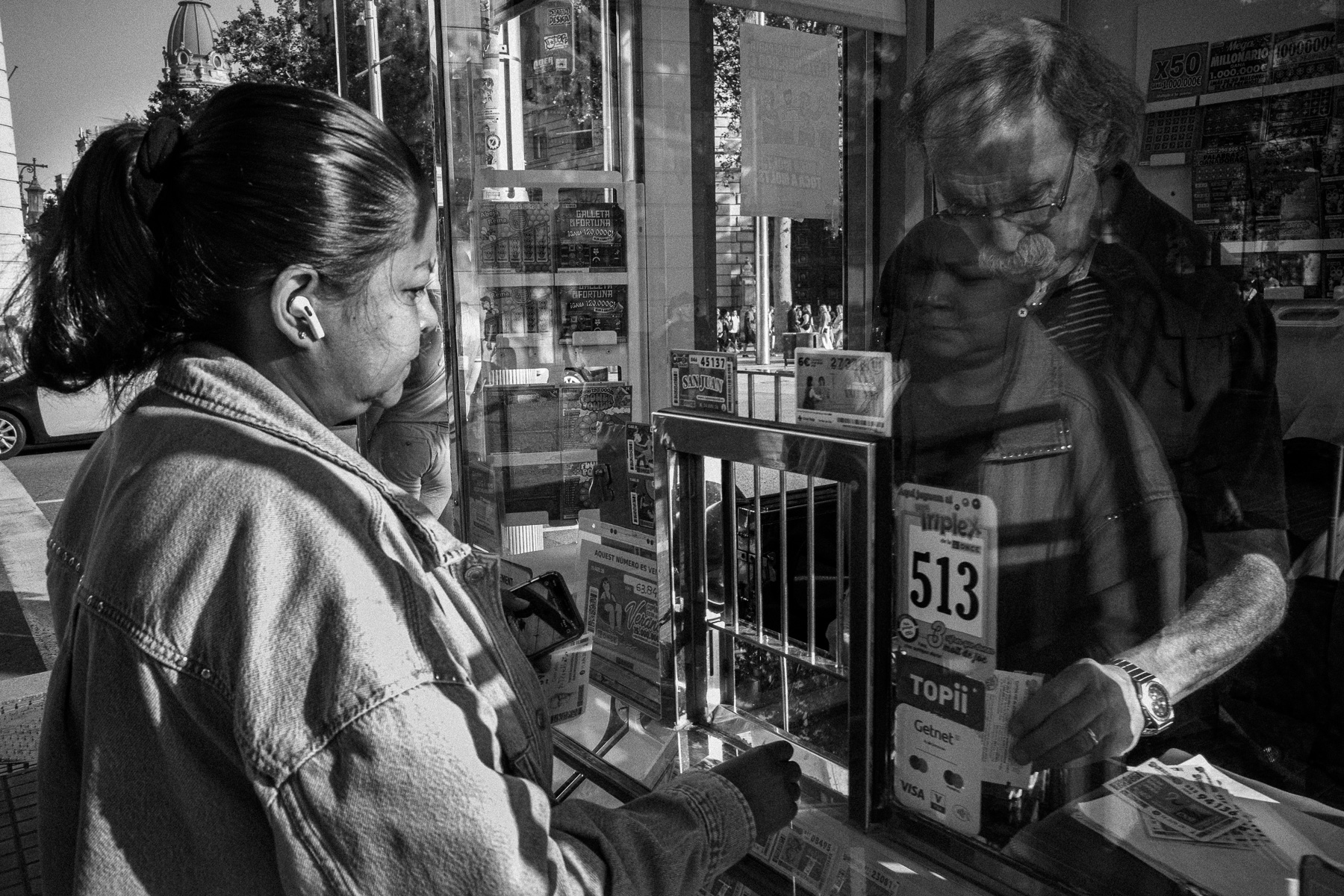
    Barcelona is all small exchanges here: lottery windows, shopfront glass, numbers, hands, waiting.

    The street is not open space. It has rules.
    A counter decides where the body stops.
    Glass keeps the gesture visible but out of reach.

    A hand comes forward.
    A number sits behind the window.
    Someone waits outside and still has to play along.

    This is not the postcard version of the city.
    It is the city as a set of limits: pay here, wait there, come closer, not that close.

  • Clock Sale

    Clock Sale

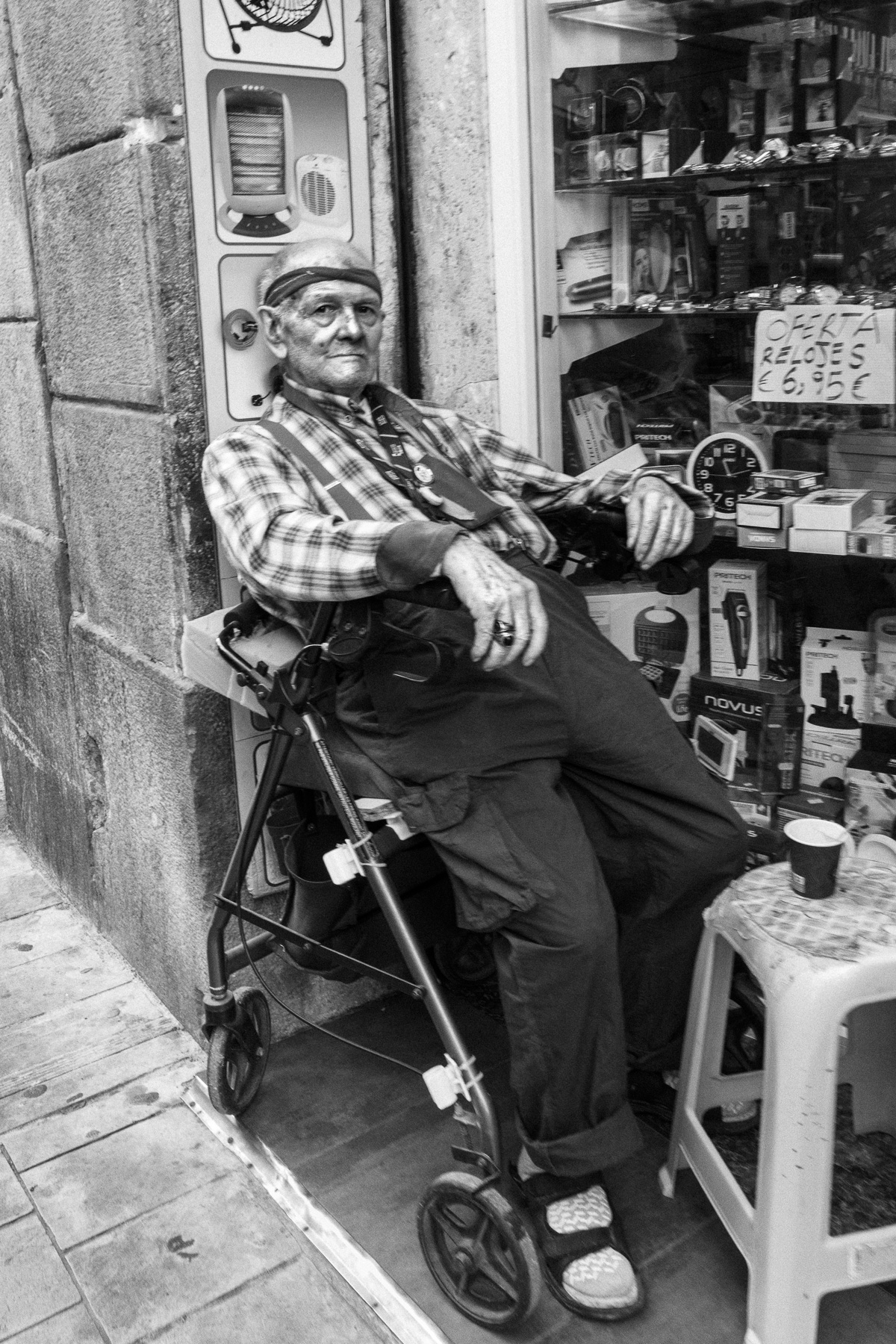
    An elderly man sitting in a walker, wearing a plaid shirt and a headband, with a serious expression, in front of a store displaying various items, in black and white.

    This week began with faces, bodies and doorways. Not portraits in the polite sense. Nobody was arranged, softened, rescued or turned into a small monument of dignity for the comfort of the viewer. The camera stayed close to the edge of the street: entrances, shopfronts, walls, bad light, tired hands, cigarettes, walkers, plastic stools, small signs, objects waiting longer than people.

    The fifth portrait sits at the end of that line.

    An older man rests outside a small shop. A walker stands in front of him, almost more frontal than the body itself. Behind him, the window is full of clocks and small objects, the kind of things that belong to shops where time seems to have stopped out of habit, not nostalgia. A handwritten sign announces watches on sale.

    Time is cheap in the window. Waiting is not.

    That small joke is what keeps the photograph from becoming too solemn. The frame has enough weight already: the seated body, the walker, the shop entrance, the crowded glass, the stool, the cup, the little domestic debris of the pavement. Everything is slightly too much, and that is why it works. The city does not give the man a clean background. It gives him inventory.

    The five portraits from this week have been circling the same problem: how a body occupies a narrow piece of public space when there is no proper place to be. A doorway becomes a chair. A wall becomes support. A shopfront becomes weather. The street does not stage these things. It just leaves them there, badly lit and perfectly clear.

    Next week, the frame opens wider.

    The portraits will give way to a Barcelona street series: less face, more city; less individual tension, more pavement, shutters, glass, crossings, corners and people reduced to the size the city allows them. Not Barcelona as postcard. Not Barcelona as Mediterranean mood with clean typography and rental prices from another moral universe.

    Barcelona as pressure.

    This photograph stays between both weeks. It belongs to the portraits, but it already points beyond them. The man is there, unmistakably, but the shop window is also there, doing its quiet damage. The clocks, the walker, the sign, the pavement. A whole city compressed into a bad little arrangement nobody designed and nobody will fix.

    The street keeps excellent records.
    It just refuses to file them properly.

    Two men in sunglasses standing outside a building; one is holding a water bottle while the other smokes a cigar.
    Preview of the next week.
  • Same Light, Different Directions

    Hard Light

    Two people walking in a city street, one wearing a white tank top and the other in a patterned shirt and cap, both laughing and enjoying their time together.

    The sun is not fair here, and it does not try to be.

    A man stays a few steps behind, dressed in white, cut open by hard light. His mouth is half open, his hand is caught in the middle of a gesture, and his eyes are already somewhere outside the frame. In front of him, a woman crosses the foreground with her cap low and a smile almost buried inside the shadow. She is larger in the photograph, but she does not explain it. He is smaller, but louder.

    The street adds the rest: open asphalt, white lines, façades, traffic lights, bicycles, a motorcycle in the distance, and that exact amount of city that always feels slightly excessive. There is no clean stage here. There is urban pressure. The background does not support the figures; it pushes against them. The city pretends to be a neutral surface, because cities enjoy that little fraud. It is not neutral. The asphalt carries weight, the crosswalk cuts the frame, the façades stand there with the old confidence of things that never apologize.

    In the first version, the whites on the man’s clothes were too loud. The tank top and shorts could have dragged the photograph into that miserable territory where everything starts to look like a detergent commercial that took a wrong turn. The highlight warnings were useful, but not as commandments. They only showed where the image was beginning to lose flesh.

    The edit moved in the opposite direction: control the whites without killing them, keep the shadow under the cap without opening it too much, give a little more weight to the man’s gesture, and let the background remain a city without letting it take over the room. The shadow on her face is not a heroic rescue mission. It belongs there. Some shadows have earned the right to stay closed.

    The final crop pulls the frame closer to the two bodies. It removes loose air, cuts down the postcard architecture, and leaves the scene in a more physical place. The point is not to make the photograph cleaner. The point is to make it readable without disinfecting it, a very human habit and, frankly, a suspicious one.

    This image belongs to Hard Light because the light is not just a technical condition. It is the force arranging the frame. It also brushes against Urban Wildlife: two bodies crossing the city like half-civilized urban animals, each with a direction, a temperature, and a small private defence.

    The street does not give them a story. It gives them too much light, a strip of asphalt, and two directions that do not quite agree.

    Technical: Ricoh GR IV Monochrome · Lightroom Classic.

  • [Review] Fotografías de guerra (1974-1985): Dust, Iron, and White Light

    [Review] Fotografías de guerra (1974-1985): Dust, Iron, and White Light

    A black and white poster for an exhibition titled 'Arturo Pérez-Reverte: Fotografías de Guerra 1974-1985', featuring a soldier in a desert setting holding a rifle.

    Fotografías de guerra (1974-1985) arrives with dust, iron, and a white light that hurts the eyes. The book demands a steady stomach, a still gaze, and very little faith in grand words.

    On the cover, an armed man aims at an empty horizon. His body carries the tension: the bent back, the long rifle, the pale clothes, the desert ahead. War is reduced to a posture. A way of crouching. A way of waiting for something worse to happen.

    The selected photographs have a dryness that works in their favour. There is grain, dust, walls scorched by the sun, sweaty clothes, weapons that weigh too much, and bodies settled into an almost physical discomfort. War, seen like this, sheds rhetoric and gathers dirt. It also gathers weight. The exact weight of a weapon, of a pocked wall, of a man crouched for too long under a light that flattens everything.

    A silhouette of a soldier running with a rifle over rugged terrain, with mountains in the background.

    One of the hardest images is that of the fighter running with the rifle across his back. The body is caught mid-thrust, low, almost animal. The violence comes from the movement, from the dust, from that slightly ridiculous urgency of running with death slung over your back. War puts men into absurd postures and then asks them to call it heroism. Humanity, once organised, produces admirable documents and massacres with logistics.

    Black and white image of three individuals in a dilapidated urban setting, two taking cover while aiming weapons, amidst debris and puddles on the ground.

    In another scene, three figures occupy a terrace or a half-ruined space. On the left, a man aims. In the centre, another throws something against a white wall covered in marks. On the right, a young woman waits with her rifle horizontal, crouched, too still for what is happening around her. The floor is filthy: rubble, puddles, scattered fragments. The wall ends up ruling the image. White, dry, punctured. A punished surface that seems more alive than the people hiding beside it.

    Silhouette of a person holding a weapon, with a view of urban buildings in the background.

    The photograph of the silhouette inside the dark opening holds in another way. The face is eaten by shadow. Only the outline of the hair, the rifle, and the city in the background remain visible. It is a quiet, persistent image. War appears there as a way of inhabiting the edge: looking from a hole, waiting from a dirty place, turning a window into a trench. Outside there are still buildings. Perhaps ordinary windows. Perhaps someone boiling coffee. History has always had this lack of manners: some shoot while others try to get on with the day.

    A man wearing goggles and a scarf, holding a rifle while sitting in the back of a vehicle against a barren landscape.

    There are also portraits in which the fighter seems dressed up as himself. A man with a turban and large goggles sits in a vehicle, with a weapon beside him and the desert behind. The goggles cover his eyes and turn him into a strange, almost unreal figure. Everything around him weighs too much: the light, the vehicle, the weapon, the empty horizon. The desert leaves things with no excuse.

    A soldier aiming a machine gun over a wall in a war-torn environment, wearing a tank top and combat pants.

    In another photograph, a man fires a machine gun from a rooftop. The belt of bullets falls like a metallic tail. Arm, jaw, torso: everything is tense. It is a physical image, almost muscular. War remains in the imagined noise, in the recoil, in the clenched teeth. Black and white works effectively here because it removes distractions. The gesture remains. The weight remains. That poor, endlessly repeated human fantasy remains: controlling the world by pulling a trigger.

    The book is at its best when it lets us forget the author’s name for a while. Pérez-Reverte carries a heavy public persona: the writer, the reporter, the academician, the professional polemicist, all that machinery trailing behind him. The photographs breathe better when they return to the place they came from: the ground, the short distance, the unstable moment, the eye that looks because it is still there.

    A bearded man running with a rifle in a dynamic pose, set against a backdrop of buildings.

    These images bear witness. And witness, when it is good, offers little comfort. The disaster stays visible with an almost administrative dryness: wall, body, weapon, shadow, dust. All very simple. All dirty enough. The camera places a concrete proof there, so war loses the air of a grand word and returns to its real place: crouched bodies, marked walls, weapons taking up too much space, light falling without pity.

    The reader is left before images that dirty the fingers. Someone was there. He looked. He fired the camera. And he came back with the kind of material that time can store, however cowardly an archivist time may be.

    You can buy this book here with a 5% discount and free shipping.

  • No Small Talk

    No Small Talk

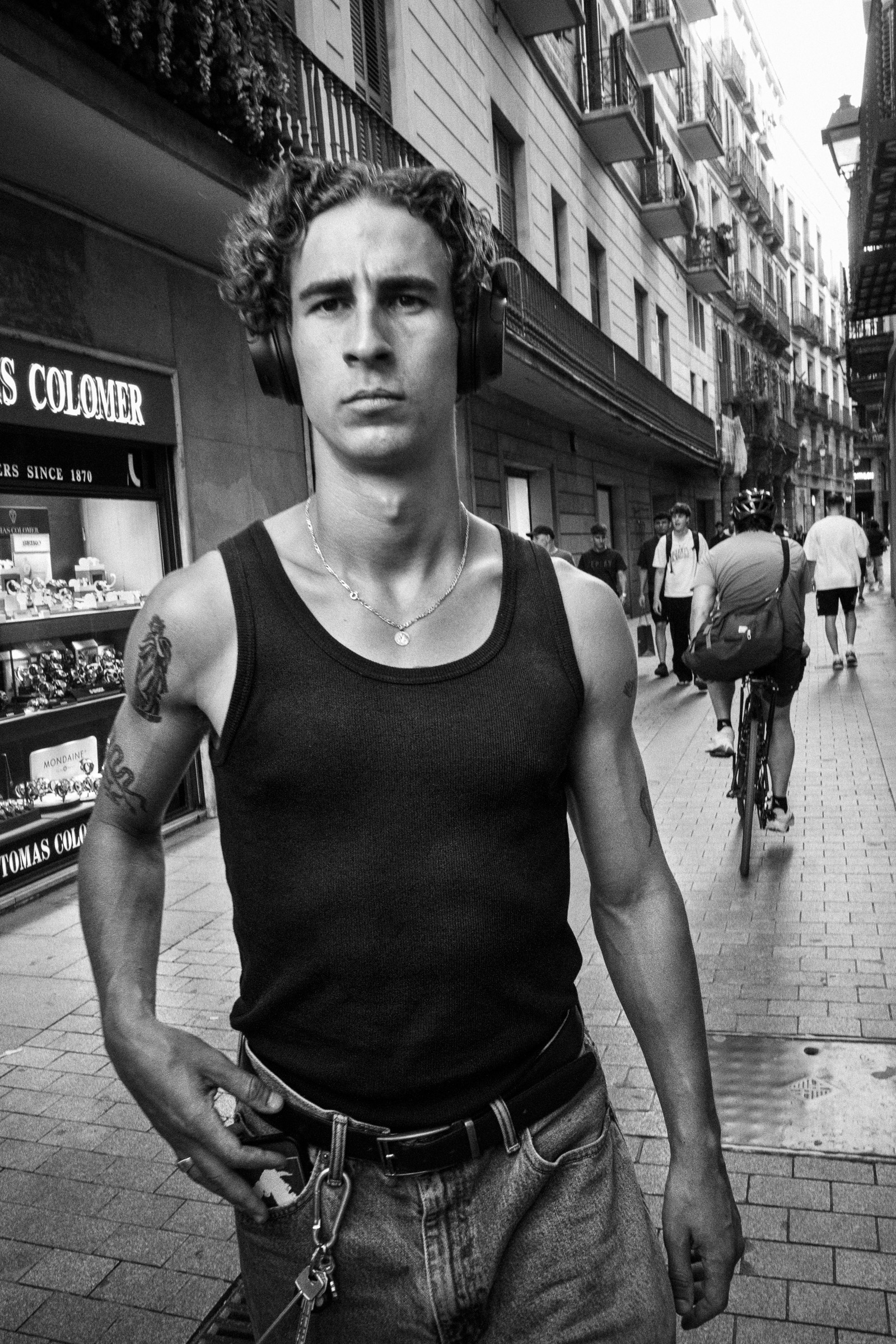
    A few portraits from Barcelona, taken over the weekend.

    Close faces. Shopfronts. Glass. Traffic. Tired walls. People holding their place while the city keeps pushing behind them.

    These are not quiet portraits, even when nothing dramatic is happening. That is partly why I like them. Nobody is performing much, but the frame still feels crowded: hands, eyes, cheap objects, passing bodies, the small pressure of the street.

    I am not looking for grand character studies here. No heroic street mythology. Just people seen at close range, with very little room to become elegant.

    Some look straight back. Some seem half elsewhere. The city does not soften around them. It stays there: dirty, busy, indifferent, useful.

    This small weekend series sits inside Portraits, close to the rougher edge of StreetSoul. More this weekend.

    Technical note: Ricoh GR IV Monochrome.

  • What Survived the Walk

    What Survived the Walk

    Most of the walk gave nothing.

    That is not a complaint. It is probably the most honest part of street photography. The street does not owe you a frame. It does not arrange people, light, walls, traffic, dogs, shop windows, or civic failure into something useful just because you left the house with a camera.

    This Field Note starts there: with the plain fact that most walking is waste.

    Not useless waste. Useful waste. The kind that sharpens the eye by refusing to reward it too quickly. You walk, you look, you miss. A corner almost gives you something. A figure arrives too late. A shadow is good but the body is wrong. A wall has promise and then behaves like a wall, which is rude but common.

    The video is not a tutorial. There is no secret method, no heroic street photography lesson, no little sermon about learning to see. It is just a record of the process before the photograph becomes clean enough to pretend it was inevitable.

    It was not inevitable.

    The few frames that stayed did so because they had some pressure inside them: a gesture that did not explain itself, a face caught in a small private weather, a body placed badly enough to become interesting, light doing more damage than decoration. That is usually enough. Not much, but enough.

    The camera only records part of the walk. The edit decides what the walk was worth.

    That is the part I care about most: not the moment of shooting, but the later cruelty of selection. Most frames die quietly. A few survive because they still resist after the first look, after the crop, after the contrast, after the temptation to make them nicer than they deserve.

    StreetSoul Field Notes will follow that line: the walk before the photograph, the failures around the frame, the small decisions that keep one image and leave the rest behind.

    Video: https://youtu.be/v-AXCoQT0eA

    Most of the walk gave nothing.

    That is not a complaint. It is probably the most honest part of street photography. The street does not owe you a frame. It does not arrange people, light, walls, traffic, dogs, shop windows, or civic failure into something useful just because you left the house with a camera.

    This Field Note starts there: with the plain fact that most walking is waste.

    Not useless waste. Useful waste. The kind that sharpens the eye by refusing to reward it too quickly. You walk, you look, you miss. A corner almost gives you something. A figure arrives too late. A shadow is good but the body is wrong. A wall has promise and then behaves like a wall, which is rude but common.

    The video is not a tutorial. There is no secret method, no heroic street photography lesson, no little sermon about learning to see. It is just a record of the process before the photograph becomes clean enough to pretend it was inevitable.

    It was not inevitable.

    The few frames that stayed did so because they had some pressure inside them: a gesture that did not explain itself, a face caught in a small private weather, a body placed badly enough to become interesting, light doing more damage than decoration. That is usually enough. Not much, but enough.

    The camera only records part of the walk. The edit decides what the walk was worth.

    That is the part I care about most: not the moment of shooting, but the later cruelty of selection. Most frames die quietly. A few survive because they still resist after the first look, after the crop, after the contrast, after the temptation to make them nicer than they deserve.

    StreetSoul Field Notes will follow that line: the walk before the photograph, the failures around the frame, the small decisions that keep one image and leave the rest behind.

    Technical note: Ricoh GR IV Monochrome · Lightroom Classic.

  • Elvis Below Ground

    Elvis Below Ground

    Absurd World

    A performer dressed in a white jumpsuit resembling Elvis Presley plays guitar in a subway station, while a few pedestrians walk by. The background features decorative tiles and advertising posters.

    An Elvis plays below ground.

    The passage is low. On the left, a cold mural, a speaker and the musician in a white suit, standing at the microphone. Above, two lights too white blow out the ceiling. In the background, the exit toward the Ramblas and a row of lightboxes advertising fast food, exhibitions and anything else still capable of asking for half a second of attention.

    The open case carries more weight than it seems. It faces the passage, waiting for people crossing the space without quite deciding whether to listen, look or keep walking. The musician stays off to one side. The case, almost at the center. Between them, the shiny floor opens a slightly unkind distance.

    The photo could have stayed at the level of a curious postcard: “look, an Elvis in an underground passage.” What held me was something drier: the city placing music, advertising, exits, dirty light and indifference inside the same corridor. Everything mixed. Everything working at once. Delicacy, predictably, had taken the day off.

    The passer-by in the background keeps the image from closing around the musician. He walks past the ads with an almost functional indifference. Elvis plays, the case waits, the ads shout, the man passes. The place continues.

    A musician dressed in a white jumpsuit performs with a guitar in a subway station, surrounded by tiled walls and advertisements, while a lone figure stands nearby.

    When editing it, I stopped chasing a complete correction. The ceiling lights were partly blown out, and I kept them that way. I could have pulled them toward a cleaner, more presentable version, more obedient to that minor religion of the perfect histogram. But the light in the passage was hard, flat, a little cruel. Softening it too much changed the temperature of the scene.

    The final crop tightens the triangle between the musician, the case and the passer-by. Only a little. There is still too much ceiling. Still too much reflection on the floor. Still that feeling of a poorly lit public place where everything happens and almost nothing stops.

    This photo belongs in Absurd World because of the whole set: an underground passage, a musician dressed as Elvis, ads promising food and culture, an exit back to the surface, and a hostile light flattening everything. The city turns any presence into another layer of noise. Here, the noise wears a white suit.

    More Absurd World here.

    Technical note: Leica M10 Monochrom · Thypoch Ksana 21mm f3.5 Asph. · Lightroom Classic.

    Before and after editing.
  • The Walk Back

    The Walk Back

    Hard Light

    Two young girls dressed in athletic clothing stand on a sidewalk, with a woman walking nearby holding a phone and a bag. The scene is in black and white, capturing a casual urban environment.

    Noon comes down hard. The concrete glares, the bodies are cut by a light that is too vertical, and the sidewalk feels narrower than it probably is. There is not much air in the image.

    At the center, two figures look toward the camera. They do not quite pose, but they do not disappear into the flow either. On the right, another scene: phone, bags, clothes, the concrete weight of walking back. Everything happens within the same strip of sidewalk, but each figure carries a different rhythm.

    I left the background as insistent as it was. The pole in the middle, the fence, the cars, the surveillance sign, the shadows too dense. I could have looked for a cleaner image. It would also have been kinder, and probably less true.

    The edit only pushes what was already there: dry contrast, harsh sun, little softness. The photograph was not asking for beauty. It was asking to keep that pressure, the uncomfortable closeness, the feeling that the street passes too near and does not wait for the frame to be ready.

    Editorial note: to protect the privacy of the minors, I have slightly altered their faces through localized digital retouching. The scene, the composition and the relationship between figures have not been altered.

    Technical note: Ricoh GR IV Monochrome · Lightroom Classic · Adobe Photoshop.

  • Pista americana

    Pista americana

    Absurd World

    The sign takes up half the scene: ATRACCIONES ARAGÓN 1. Below it, the promise becomes more specific: PISTA AMERICANA. Everything points to play, noise, movement. The photograph answers with a pause.

    The tent dominates the centre, too large a structure for so little action. On the left, a woman in dark sunglasses holds the leash while the dog pulls out of the frame. On the right, a man sits with his phone; the helmet rests on the scooter. Between them, an open stretch of pavement marks the place where something should happen.

    The photograph belongs to Absurd World because of that gap between what the street promises and what it finally gives. The sign shouts attraction. The scene delivers waiting, sun, and a slightly ridiculous stillness.

    The original capture already held the image: woman, dog, tent, sign, seated man, central void. The problem was the overall grey. The tent and pavement took up a lot of space, but they did not guide the eye enough. The figures were readable, but too evenly held inside a flat light.

    The crop has barely changed. The central void is the track. Closing it down would have made the photograph neater and less uncomfortable. That space keeps the failed promise alive: movement announced, action absent.

    The edit focused on contrast and on controlling the whites. The tent needed presence without swallowing the sign. The pavement had to keep the hardness of the sun without looking washed out. The shadows of the trees and the inside of the attraction now carry more weight. The woman and the dog enter the reading more clearly. The man on the right stays fixed inside the pause.

    The sign is not decoration. Without it, the scene would be a fairground at rest. With it, the pause turns drier. Pista Americana suggests obstacles, effort, a body in motion. The image shows another kind of test: enduring the sun, waiting, looking at a screen, letting the dog pull you toward a better direction.

    The absurd was already inside the capture. The edit only removed the grey film over it, separated the planes, and let the contradiction breathe: an attraction without action, a track with no one on it, a huge sign announcing an energy the photograph refuses to deliver.

    Technical note: Ricoh GR IV Monochrome · Lightroom Classic.

    More Absurd World here.

    Before and after editing.
  • Too Bright for the Street

    Too Bright for the Street

    Absurd World · before / middle / final

    A person wearing a large inflatable pig costume stands on a street surrounded by other individuals. The scene is set in an urban area with parked cars and buildings in the background. The atmosphere appears lively and social.

    A white inflatable body in the middle of the street. A human face coming out of the costume’s mouth. A man on the left with a phone. A young woman looking in from the right. Scooters, signs, people passing, a dark head cutting into the foreground.

    The photograph already had enough noise. It did not need much help.

    A group of people interacting on a street, with one person wearing a large inflatable pig costume while holding a microphone. The scene is in black and white, with a few people engaged in conversation and vehicles parked in the background.

    The problem was the white. Too large, too clean, too ready to turn the scene into an easy joke. In the first version, the costume sat in the frame as a flat bright mass. The street fell behind it, reduced to background. But this picture is not really about the costume. It is about the street accepting it without blinking.

    A person wearing a pig costume is posing for a photo while surrounded by friends on a lively street. Some people are laughing and interacting with each other, capturing a fun moment.

    The middle edit brought back more information, but it made the image too open. The frame became easier to read, and less tense. The costume still ruled the scene. The glances around it lost weight. The photograph needed less polish and more street.

    A person dressed in a large pig costume stands in a street surrounded by people, some are talking and others are observing, in a lively urban setting.

    In the final version, the white still holds the centre. It should. But it no longer empties the rest of the frame. The costume keeps its volume. The face inside becomes clearer. The man on the left enters the scene with his phone and hanging camera. The young woman on the right does not look shocked, or quite indifferent. She has the calm of someone trained by the street: absurdity appears, and life keeps moving.

    The dark head in the foreground stays too. A cleaner frame would probably be weaker. That obstruction closes the image and keeps it inside the crowd, not on a stage arranged for the viewer.

    This photograph belongs to Absurd World because of that mix: a costume too white, a street too full, and a kind of normality that refuses to react properly. The edit only had to contain the excess. Let the ridiculous shine, but not so much that it burned the rest of the photograph.

    More Absurd World here.

    Technical: Leica M10 Monochrom · Summicrom-M 35mm F2 · Lightroom Classic.