Author: Jaume Salvà

  • What Survived the Walk

    What Survived the Walk

    Most of the walk gave nothing.

    That is not a complaint. It is probably the most honest part of street photography. The street does not owe you a frame. It does not arrange people, light, walls, traffic, dogs, shop windows, or civic failure into something useful just because you left the house with a camera.

    This Field Note starts there: with the plain fact that most walking is waste.

    Not useless waste. Useful waste. The kind that sharpens the eye by refusing to reward it too quickly. You walk, you look, you miss. A corner almost gives you something. A figure arrives too late. A shadow is good but the body is wrong. A wall has promise and then behaves like a wall, which is rude but common.

    The video is not a tutorial. There is no secret method, no heroic street photography lesson, no little sermon about learning to see. It is just a record of the process before the photograph becomes clean enough to pretend it was inevitable.

    It was not inevitable.

    The few frames that stayed did so because they had some pressure inside them: a gesture that did not explain itself, a face caught in a small private weather, a body placed badly enough to become interesting, light doing more damage than decoration. That is usually enough. Not much, but enough.

    The camera only records part of the walk. The edit decides what the walk was worth.

    That is the part I care about most: not the moment of shooting, but the later cruelty of selection. Most frames die quietly. A few survive because they still resist after the first look, after the crop, after the contrast, after the temptation to make them nicer than they deserve.

    StreetSoul Field Notes will follow that line: the walk before the photograph, the failures around the frame, the small decisions that keep one image and leave the rest behind.

    Video: https://youtu.be/v-AXCoQT0eA

    Most of the walk gave nothing.

    That is not a complaint. It is probably the most honest part of street photography. The street does not owe you a frame. It does not arrange people, light, walls, traffic, dogs, shop windows, or civic failure into something useful just because you left the house with a camera.

    This Field Note starts there: with the plain fact that most walking is waste.

    Not useless waste. Useful waste. The kind that sharpens the eye by refusing to reward it too quickly. You walk, you look, you miss. A corner almost gives you something. A figure arrives too late. A shadow is good but the body is wrong. A wall has promise and then behaves like a wall, which is rude but common.

    The video is not a tutorial. There is no secret method, no heroic street photography lesson, no little sermon about learning to see. It is just a record of the process before the photograph becomes clean enough to pretend it was inevitable.

    It was not inevitable.

    The few frames that stayed did so because they had some pressure inside them: a gesture that did not explain itself, a face caught in a small private weather, a body placed badly enough to become interesting, light doing more damage than decoration. That is usually enough. Not much, but enough.

    The camera only records part of the walk. The edit decides what the walk was worth.

    That is the part I care about most: not the moment of shooting, but the later cruelty of selection. Most frames die quietly. A few survive because they still resist after the first look, after the crop, after the contrast, after the temptation to make them nicer than they deserve.

    StreetSoul Field Notes will follow that line: the walk before the photograph, the failures around the frame, the small decisions that keep one image and leave the rest behind.

    Technical note: Ricoh GR IV Monochrome · Lightroom Classic.

  • Elvis Below Ground

    Elvis Below Ground

    Absurd World

    A performer dressed in a white jumpsuit resembling Elvis Presley plays guitar in a subway station, while a few pedestrians walk by. The background features decorative tiles and advertising posters.

    An Elvis plays below ground.

    The passage is low. On the left, a cold mural, a speaker and the musician in a white suit, standing at the microphone. Above, two lights too white blow out the ceiling. In the background, the exit toward the Ramblas and a row of lightboxes advertising fast food, exhibitions and anything else still capable of asking for half a second of attention.

    The open case carries more weight than it seems. It faces the passage, waiting for people crossing the space without quite deciding whether to listen, look or keep walking. The musician stays off to one side. The case, almost at the center. Between them, the shiny floor opens a slightly unkind distance.

    The photo could have stayed at the level of a curious postcard: “look, an Elvis in an underground passage.” What held me was something drier: the city placing music, advertising, exits, dirty light and indifference inside the same corridor. Everything mixed. Everything working at once. Delicacy, predictably, had taken the day off.

    The passer-by in the background keeps the image from closing around the musician. He walks past the ads with an almost functional indifference. Elvis plays, the case waits, the ads shout, the man passes. The place continues.

    A musician dressed in a white jumpsuit performs with a guitar in a subway station, surrounded by tiled walls and advertisements, while a lone figure stands nearby.

    When editing it, I stopped chasing a complete correction. The ceiling lights were partly blown out, and I kept them that way. I could have pulled them toward a cleaner, more presentable version, more obedient to that minor religion of the perfect histogram. But the light in the passage was hard, flat, a little cruel. Softening it too much changed the temperature of the scene.

    The final crop tightens the triangle between the musician, the case and the passer-by. Only a little. There is still too much ceiling. Still too much reflection on the floor. Still that feeling of a poorly lit public place where everything happens and almost nothing stops.

    This photo belongs in Absurd World because of the whole set: an underground passage, a musician dressed as Elvis, ads promising food and culture, an exit back to the surface, and a hostile light flattening everything. The city turns any presence into another layer of noise. Here, the noise wears a white suit.

    More Absurd World here.

    Technical note: Leica M10 Monochrom · Thypoch Ksana 21mm f3.5 Asph. · Lightroom Classic.

    Before and after editing.
  • The Walk Back

    The Walk Back

    Hard Light

    Two young girls dressed in athletic clothing stand on a sidewalk, with a woman walking nearby holding a phone and a bag. The scene is in black and white, capturing a casual urban environment.

    Noon comes down hard. The concrete glares, the bodies are cut by a light that is too vertical, and the sidewalk feels narrower than it probably is. There is not much air in the image.

    At the center, two figures look toward the camera. They do not quite pose, but they do not disappear into the flow either. On the right, another scene: phone, bags, clothes, the concrete weight of walking back. Everything happens within the same strip of sidewalk, but each figure carries a different rhythm.

    I left the background as insistent as it was. The pole in the middle, the fence, the cars, the surveillance sign, the shadows too dense. I could have looked for a cleaner image. It would also have been kinder, and probably less true.

    The edit only pushes what was already there: dry contrast, harsh sun, little softness. The photograph was not asking for beauty. It was asking to keep that pressure, the uncomfortable closeness, the feeling that the street passes too near and does not wait for the frame to be ready.

    Editorial note: to protect the privacy of the minors, I have slightly altered their faces through localized digital retouching. The scene, the composition and the relationship between figures have not been altered.

    Technical note: Ricoh GR IV Monochrome · Lightroom Classic · Adobe Photoshop.

  • Pista americana

    Pista americana

    Absurd World

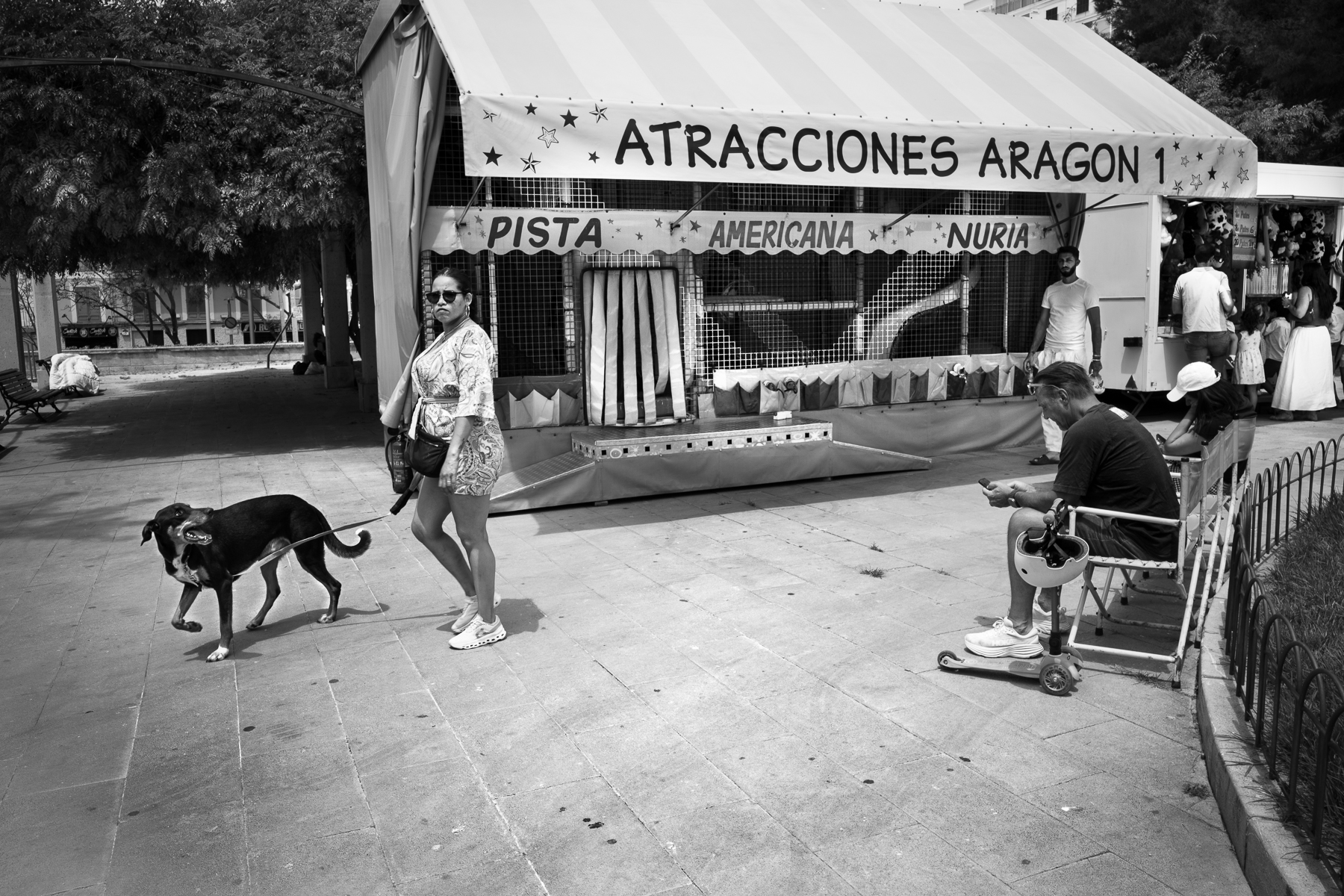
    The sign takes up half the scene: ATRACCIONES ARAGÓN 1. Below it, the promise becomes more specific: PISTA AMERICANA. Everything points to play, noise, movement. The photograph answers with a pause.

    The tent dominates the centre, too large a structure for so little action. On the left, a woman in dark sunglasses holds the leash while the dog pulls out of the frame. On the right, a man sits with his phone; the helmet rests on the scooter. Between them, an open stretch of pavement marks the place where something should happen.

    The photograph belongs to Absurd World because of that gap between what the street promises and what it finally gives. The sign shouts attraction. The scene delivers waiting, sun, and a slightly ridiculous stillness.

    The original capture already held the image: woman, dog, tent, sign, seated man, central void. The problem was the overall grey. The tent and pavement took up a lot of space, but they did not guide the eye enough. The figures were readable, but too evenly held inside a flat light.

    The crop has barely changed. The central void is the track. Closing it down would have made the photograph neater and less uncomfortable. That space keeps the failed promise alive: movement announced, action absent.

    The edit focused on contrast and on controlling the whites. The tent needed presence without swallowing the sign. The pavement had to keep the hardness of the sun without looking washed out. The shadows of the trees and the inside of the attraction now carry more weight. The woman and the dog enter the reading more clearly. The man on the right stays fixed inside the pause.

    The sign is not decoration. Without it, the scene would be a fairground at rest. With it, the pause turns drier. Pista Americana suggests obstacles, effort, a body in motion. The image shows another kind of test: enduring the sun, waiting, looking at a screen, letting the dog pull you toward a better direction.

    The absurd was already inside the capture. The edit only removed the grey film over it, separated the planes, and let the contradiction breathe: an attraction without action, a track with no one on it, a huge sign announcing an energy the photograph refuses to deliver.

    Technical note: Ricoh GR IV Monochrome · Lightroom Classic.

    More Absurd World here.

    Before and after editing.
  • Too Bright for the Street

    Too Bright for the Street

    Absurd World · before / middle / final

    A person wearing a large inflatable pig costume stands on a street surrounded by other individuals. The scene is set in an urban area with parked cars and buildings in the background. The atmosphere appears lively and social.

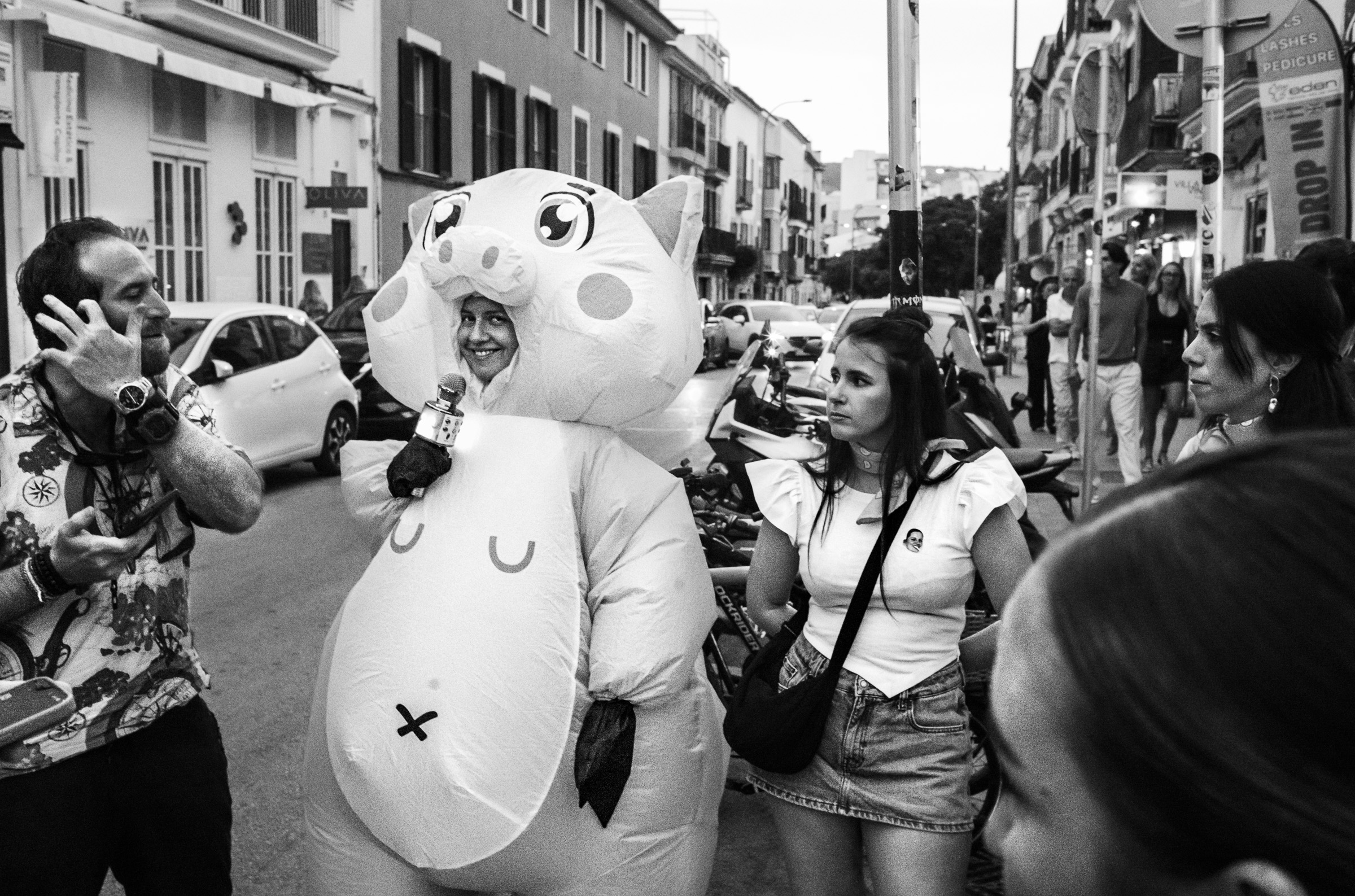
    A white inflatable body in the middle of the street. A human face coming out of the costume’s mouth. A man on the left with a phone. A young woman looking in from the right. Scooters, signs, people passing, a dark head cutting into the foreground.

    The photograph already had enough noise. It did not need much help.

    A group of people interacting on a street, with one person wearing a large inflatable pig costume while holding a microphone. The scene is in black and white, with a few people engaged in conversation and vehicles parked in the background.

    The problem was the white. Too large, too clean, too ready to turn the scene into an easy joke. In the first version, the costume sat in the frame as a flat bright mass. The street fell behind it, reduced to background. But this picture is not really about the costume. It is about the street accepting it without blinking.

    A person wearing a pig costume is posing for a photo while surrounded by friends on a lively street. Some people are laughing and interacting with each other, capturing a fun moment.

    The middle edit brought back more information, but it made the image too open. The frame became easier to read, and less tense. The costume still ruled the scene. The glances around it lost weight. The photograph needed less polish and more street.

    A person dressed in a large pig costume stands in a street surrounded by people, some are talking and others are observing, in a lively urban setting.

    In the final version, the white still holds the centre. It should. But it no longer empties the rest of the frame. The costume keeps its volume. The face inside becomes clearer. The man on the left enters the scene with his phone and hanging camera. The young woman on the right does not look shocked, or quite indifferent. She has the calm of someone trained by the street: absurdity appears, and life keeps moving.

    The dark head in the foreground stays too. A cleaner frame would probably be weaker. That obstruction closes the image and keeps it inside the crowd, not on a stage arranged for the viewer.

    This photograph belongs to Absurd World because of that mix: a costume too white, a street too full, and a kind of normality that refuses to react properly. The edit only had to contain the excess. Let the ridiculous shine, but not so much that it burned the rest of the photograph.

    More Absurd World here.

    Technical: Leica M10 Monochrom · Summicrom-M 35mm F2 · Lightroom Classic.

  • [Review] Colita: Nosaltres no tenim por, nosaltres som

    [Review] Colita: Nosaltres no tenim por, nosaltres som

    A black and white photograph of a protest scene from the first LGTBI+ demonstration in Barcelona on June 26, 1977. A person with short, light hair and a strappy top raises their arm confidently, surrounded by other demonstrators holding banners.

    On June 26, 1977, La Rambla did not simply watch a demonstration pass by: it had to swallow a presence the country had preferred to keep outside the frame.

    Nosaltres no tenim por, nosaltres som, by Colita, published by La Fábrica, returns to that day without turning it into a democratic postcard. Barcelona had just come out of the first elections after the dictatorship, but the street still smelled of surveillance, dirty laws, and old morality. Eleven days later, hundreds of people occupied La Rambla to demand sexual freedom. It was not a comfortable celebration. It was a public appearance. And at that moment, appearing in public was already a form of risk.

    The book brings together forty photographs by Colita, along with texts that place them in context without locking them inside a display case. That matters. Visual memory, when polished too much, ends up looking like institutional furniture: correct, white, still, harmless. This volume avoids that excessive cleaning. The images still carry noise. They still have the street on them. Someone could almost step out of the frame and keep walking.

    Colita does not photograph a cause already accepted. She photographs a collision. A group of bodies stepping in front of a city that still did not know whether to look at them, push them aside, or let the police do the dirty work. The banners matter, but they do not rule the scene alone. The faces do. The eyes. The open mouths. The hands. People moving forward without the later protection of anniversaries, exhibitions, and commemorative plaques. Before history becomes history, it is always someone being afraid in public.

    The title has the force of a sentence that does not beg: Nosaltres no tenim por, nosaltres som. We are not afraid, we are. It does not ask for tolerance. It does not seek approval. It does not offer a polite request so normality can have time to digest it. It states existence. And in that context, that was far more uncomfortable than any well-mannered slogan. “We are” cuts clean. It does not decorate, soften, or apologise. Colita understands that force and lets it breathe.

    Her gaze does not embalm the scene. Nor does it turn it into cheap epic. What appears in these photographs is more interesting than epic: a mixture of defiance, precariousness, nervous joy, and exposure. People in the street with the body as the only argument available. Democracy was still recent, but repression had not vanished at once, as if someone had switched off a light. Laws, stares, and batons have a longer memory than speeches.

    One of the strongest images is the front line of the demonstration, with trans figures and travestis occupying the lead. That position is not ornamental. It is political because it is physical. Being at the front means receiving the gaze, the insult, the blow, the photograph, and history before anyone else. Colita records this without softening it. She does not turn those bodies into clean symbols. She lets them remain specific people in a specific moment, which is much harder and much more valuable.

    The book holds because it does not separate struggle from flesh. Too many political accounts end up speaking of rights as if they appeared through natural ripening, like fruit on a civilised branch. That is not how it works. Someone goes out into the street. Someone holds the gaze. Someone shouts. Someone gets hit. Someone decides they have had enough of living in a lowered voice. Later come the laws, the narratives, the forewords, and the catalogues. Before that, always, there is the body.

    Colita had that rare virtue: she knew Barcelona was not a sentimental backdrop, but a surface of friction. In Nosaltres no tenim por, nosaltres som, La Rambla is neither postcard nor urban myth. It is an occupied place. The street weighs. The façades weigh. The crowd weighs. And in the middle of it all, each face keeps a kind of stubborn fragility, as if pride and fear were not opposites but temporary companions.

    Documentary photography can easily fall into two traps: the coldness of the archive or the sentimentality of the noble cause. This book escapes both well enough because Colita looks closely, but does not caress. She does not need to explain that this mattered. She leaves it visible. Importance does not come from an adjective. It comes from a gesture held too long in front of a country that had not yet learned to look without punishing.

    This volume is not here to reassure anyone. It is here to remind us that many freedoms began as a public nuisance. An interruption. A crowd that decided existing in private was no longer enough.

    You can buy this book here with 5% discount and free shipment.

  • When the Statue Came Back from the Dark

    When the Statue Came Back from the Dark

    Moscow · Yashica Mat 124G · Absurd World

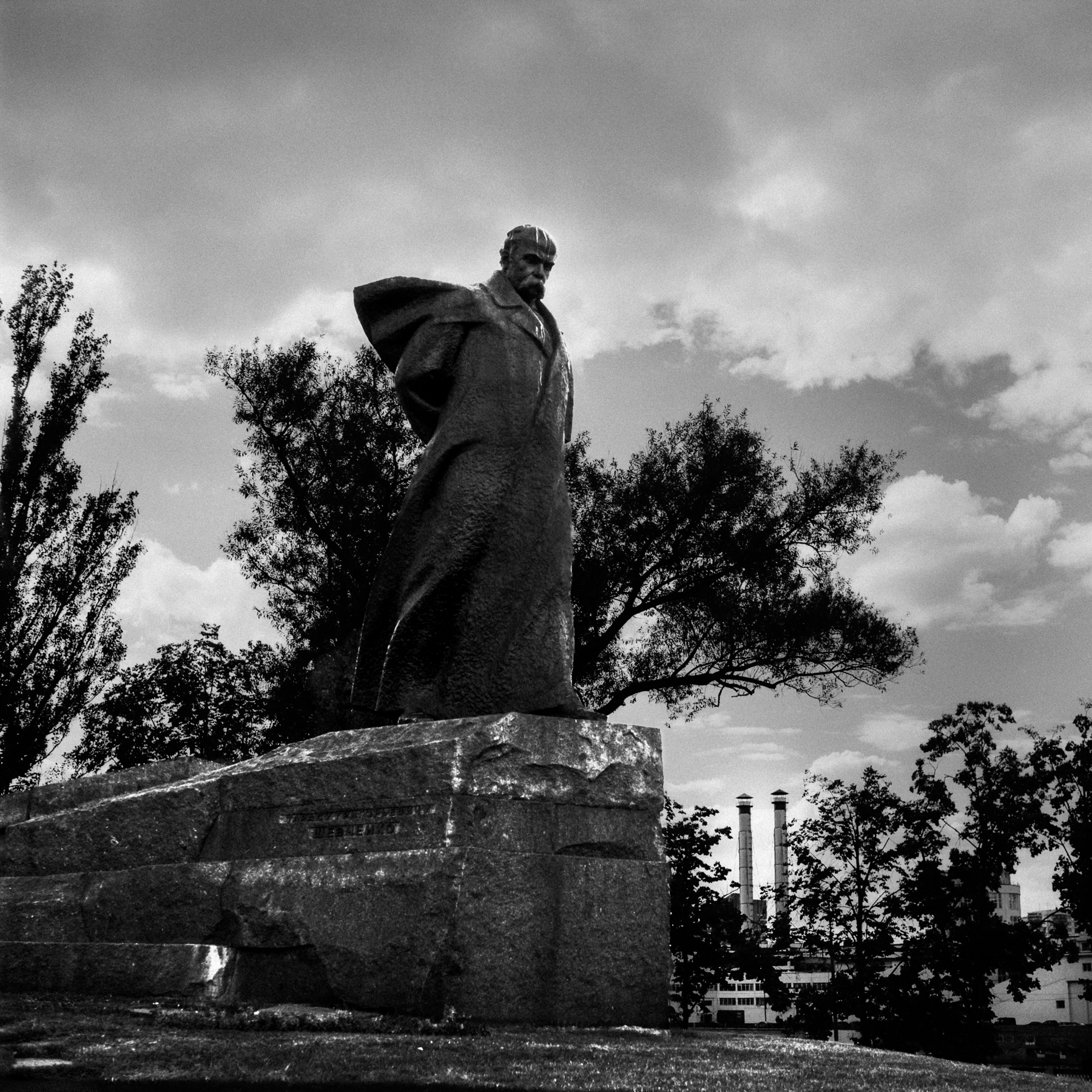
    This photograph first appeared as a black mass against the sky. A heavy, almost mute figure standing among trees, clouds and distant chimneys. Public grandeur, nature and industry shared the same frame with the usual lack of subtlety that monuments and cities seem to enjoy.

    Silhouette of a statue against a cloudy sky, with trees and industrial structures in the background.

    The original scan had force. Darkness turned the statue into an apparition. It also made the image too closed. The figure swallowed the stone, the pedestal and much of the scene around it. The photograph kept its mystery, but lost its body.

    The first pass in Lightroom Classic opened the image. Texture returned to the monument. The base separated from the ground. The figure gained matter again. That created a different risk: too much recovery would make the photograph too readable. This image needed to keep dragging part of its original darkness behind it.

    A black and white photograph of a statue depicting a man in a flowing robe, standing atop a stone base with trees and a factory smokestack in the background.

    The final version stays in that uneasy place. The statue is no longer just a black shape, yet it has not fully escaped the shadow. The sky keeps its weight. The trees still interfere with the outline. The chimneys in the distance, small and stubborn, cut through any heroic reading of the scene. The monument seems aimed at grandeur; the world around it points to something less noble, more ambiguous and much more real.

    A black and white photo of a tall statue of a man in a long coat, standing on a stone pedestal. The statue faces forward with arms behind its back, surrounded by trees and a cloudy sky.

    The photograph belongs to Absurd World because of that collision. A solemn statue under a sky that feels almost theatrical. Trees eating into its shape. Industrial chimneys appearing in the background like a prosaic footnote in a scene trying to act elevated. The monument wants the centre. The rest of the world refuses to behave. Reality has always been good at ruining speeches.

    The edit was never about saving a dark photograph. The decision was narrower and more useful: how much shadow the image should keep. The first version had truth, with too little information. The middle version brought back detail, but weakened the tension. The final image lets the statue return from the dark without granting it a clean exit.

    Editing, here, meant deciding which part of the shadow still belonged to the photograph.

    More Absurd World here.

    Before and after editing.
  • When the Crop Finds the Photograph

    When the Crop Finds the Photograph

    I am not much in favour of cropping as a habit. If an image comes back from the street needing too much surgery, maybe I did not really see it when I had the chance. But some files carry a clearer photograph inside them. This was one of those.

    The image was made with the Ricoh GR IV Monochrome. The original file already had enough material: hard light, weighted shadows, three active faces and a tonal range flexible enough to work with. The problem was the excess around it. Too much park, too much margin, too much information at the edges. Everything was happening inside the frame, but nothing was being forced strongly enough into view.

    The crop was the main decision. Not to make the photograph more “correct”, that sad little word when applied to photography, but to bring the bodies closer together and tighten the relationship between them. The bench was already giving the frame a useful diagonal, but in the original it was too dissolved into the scene. Once the frame was tightened, that line began to organize the image: it holds the three figures, separates the planes and stops the eye from escaping too quickly into the background.

    The right edge needed care. The woman sits very close to the limit of the frame, and that cut could easily have slipped into error. I left just enough air for the frame to press on her without pushing her out. With more space, the photograph lost tension. With less, the cut became too visible.

    I also corrected the tilt slightly. I was not looking for immaculate geometry. In street photography, too much perfection can leave everything a bit dead, like a staged scene designed to sell municipal benches. I only wanted the frame to stop distracting, so the tension came from the bodies rather than from an accidental slant.

    The upper part of the background was too noisy. Leaves, façades, patches of sun and small figures were competing with the faces. I used a very soft linear mask from the top, lowering exposure, highlights and whites a little. I did not want to darken the park or manufacture drama. I just wanted the background to speak more quietly.

    The white areas needed separate treatment. The pale clothing of the woman in the centre and the bag on the right pulled the eye too strongly. I controlled them locally, without killing them completely. The light still had to remain hard, because that hardness belongs to the photograph. What could not happen was for a white bag to take command over a face.

    The overall contrast went up, but not as a show of force. The blacks needed to give structure to the bench, the bags, the trousers and the shadows on the ground. The midtones had to keep skin, fabric and texture. When the grey becomes too clean, the image turns polite. This scene was not asking for politeness.

    The final grain is not decoration. It roughens the surface a little and removes that digital cleanliness that often makes photographs look finished before they have even started. With this file from the Ricoh GR IV Monochrome, the grain holds well: it gives body to the flat areas and follows the dry light without becoming the subject.

    Here the crop does not rescue a weak photograph. It concentrates it. It removes air, lowers the background, controls the whites and lets the three faces do the work. The open version showed a park scene. The final version is tighter, rougher and harder to avoid.

    More Urban Wildlife here.

    Before and after editing.
  • Borrowed Light

    Borrowed Light

    He turns back for a second, caught between the bike and the road. Not a pose. More like he heard the city say his name, which is probably giving the city too much credit.

    The photograph would lose something if it were cleaner. The cars, the sign, the glare on the helmet, the bicycle cutting into the body: all that noise keeps him in the street. It stops the portrait from behaving.

    I like that the light is not kind. It hits the helmet, hardens the face, leaves the background busy. He looks back, but nothing else stops for him.

    Ricoh GR IV Monochrome · Lightroom Classic

    More portraits here.

  • Tablet Wildlife

    Tablet Wildlife

    Museums teach a special kind of obedience.

    People enter and lower their voices. Marble does that. Painted ceilings help. So do guards, ropes, labels and the quiet pressure of everyone else pretending to know how to stand in front of history.

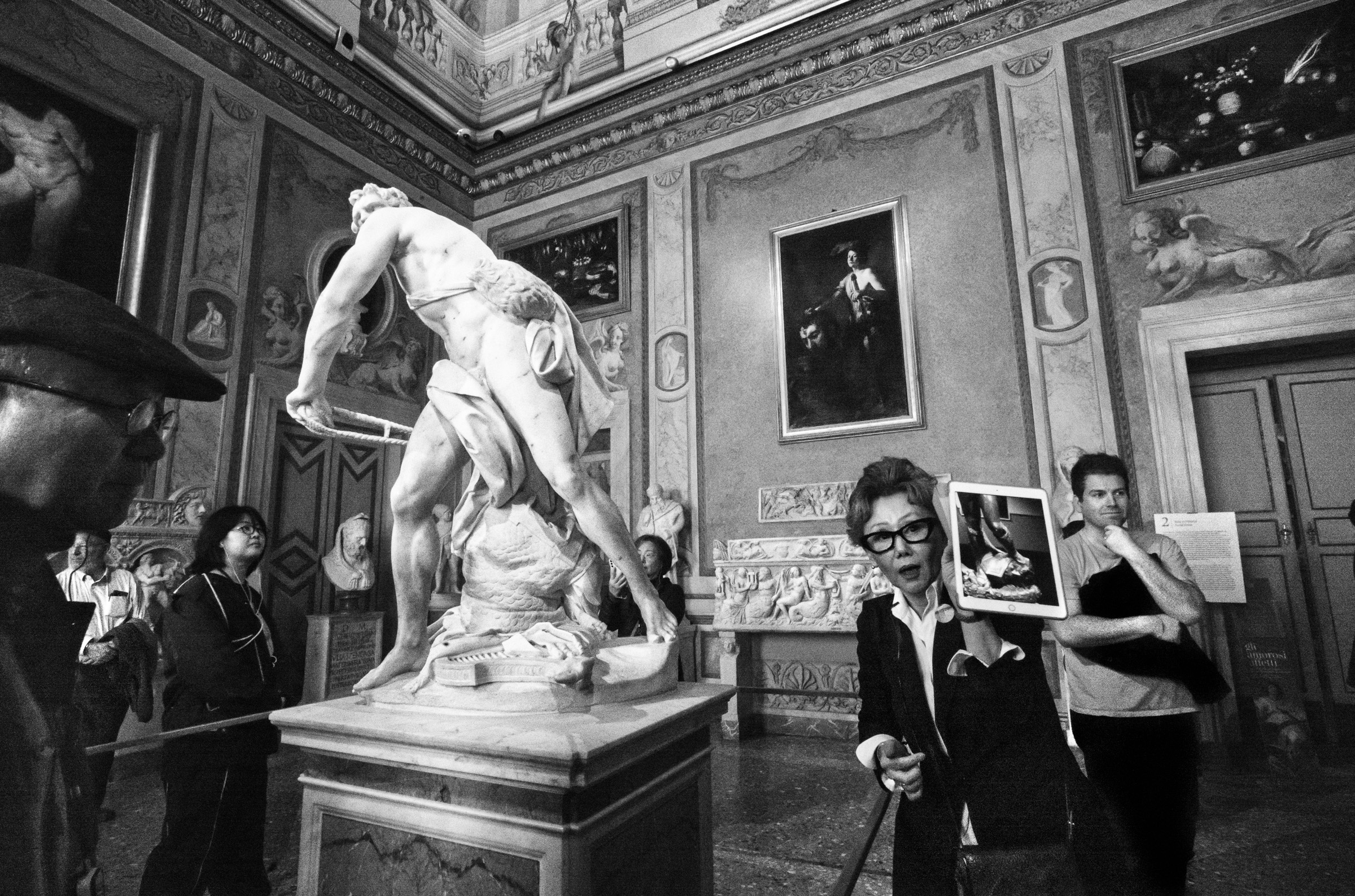
    In the center of the room, a classical body twists in stone. Muscle, drama, old violence polished into culture. It carries the kind of authority that comes from having survived centuries of dust, restoration, school groups and catalogues.

    Then the guide raises a tablet.

    The movement is small. A few heads turn. A few eyes leave the statue. The glowing rectangle gathers the room without asking for permission. The marble keeps its pose. The screen gets the pulse.

    This is Urban Wildlife in formal clothes.

    The museum becomes a habitat with rules. Visitors move through it by instinct and training: pause here, look there, follow the voice, keep close to the group, show interest, shift weight from one tired foot to the other. Culture has its choreography. The body learns it quickly.

    The ultra-wide lens lets the room crowd itself. Walls lean in. Paintings watch from above. Frames, doors, busts and faces compete for space. The statue bends into the frame while the guide leans forward, tablet raised like evidence. At the edges, people hover between attention and disappearance.

    Everything in the image is looking for a place to stand.

    The old body holds the center.
    The new image steals the glance.
    The guide translates.
    The visitors drift, gather, wait.

    A museum promises order, but the photograph catches the animal movement underneath: the herd around the object, the pull of the screen, the learned patience of people who came to look and still need to be shown where.

    Urban wildlife can happen under painted ceilings. It can wear glasses, carry a bag and stand politely beside a statue while a battery-powered image takes over the room.

    More Urban Wildlife here.

    Technical: Leica M10 Monochrom · Atoll Ultra-Wide 17mm f/2.8

    Before and after editing.